Get the latest
Subscribe to our email newsletters and stay up to speed on responsible business.
Not all supply chain risks are equal. Forced labour concentrates in specific sectors, in specific geographies, and in specific labour arrangements — and understanding where the risk is highest is the starting point for any meaningful risk assessment.
This page sets out the sectors and sourcing regions where forced labour risk is most significant, what drives that risk in each context, and how to use this information in practice. It is intended as a starting point for prioritisation, not a definitive map: risk is shaped by how you source as much as where and what you source, and the same sector can carry very different levels of risk depending on purchasing practices, labour recruitment methods, and the depth of your supplier relationships.
For guidance on how to apply this risk information in your supply chain assessment, see: How to identify forced labour in your supply chain
Forced labour risk is not random. It concentrates where certain structural conditions combine:
Labour intensity and cost pressure. Sectors that compete primarily on price, and in which labour is the primary variable cost, face the strongest commercial pressure to cut corners on labour practices. This creates conditions in which exploitative arrangements — recruitment fees, wage withholding, excessive overtime — become systemic rather than exceptional.
Reliance on migrant and informal labour. Workforces composed primarily of migrant workers — particularly cross-border migrants recruited through agencies — carry substantially higher forced labour risk. Workers who have paid recruitment fees to secure employment, who do not speak the local language, and who lack legal status or knowledge of their rights are disproportionately vulnerable to coercion.
Informality and subcontracting. Risk concentrates in the informal parts of supply chains — among subcontractors, homeworkers, labour agencies, and raw material producers — where employer accountability is lowest and worker protections are weakest. Many brands have strong relationships with their Tier 1 suppliers and little knowledge of who supplies those suppliers.
Weak governance and enforcement. Forced labour is more likely to persist in contexts where labour law enforcement is weak, where governments are unable or unwilling to investigate and prosecute exploitation, or where state-imposed forced labour is itself a feature of the production system.
These structural drivers interact: a sector that is labour-intensive, reliant on migrant labour, dependent on informal subcontracting, and sourced from a country with weak governance carries compounded risk that cannot be adequately captured by looking at any single factor alone.
Agriculture and fishing account for a disproportionate share of global forced labour in the private economy. According to UNODC’s 2022 Global Report on Trafficking in Persons, forced labour is especially prevalent in the food supply chain, particularly in agriculture and farming (29%) and the fishing industry (28%).
Several structural features explain this concentration. Agricultural work is highly seasonal, creating labour demand spikes that are typically met through informal labour agencies and migrant workers. Work is often remote, dispersed across small farms or fishing vessels that are structurally difficult to audit. Pay is frequently piece-rate, creating conditions in which workers may work very long hours for very low effective wages, and in which deductions can easily conceal exploitation. And the workforce is disproportionately composed of migrant workers with acute vulnerability to debt bondage and document retention.
Cotton — State-imposed forced labour in cotton production has been documented in Xinjiang (China), Uzbekistan (though the situation has improved following sustained international pressure and the removal of Uzbekistan from the US ILAB list), and Turkmenistan. Xinjiang’s cotton production remains subject to the US Uyghur Forced Labor Prevention Act’s rebuttable presumption, meaning any cotton-containing products with Xinjiang exposure face potential import restrictions in the US market.
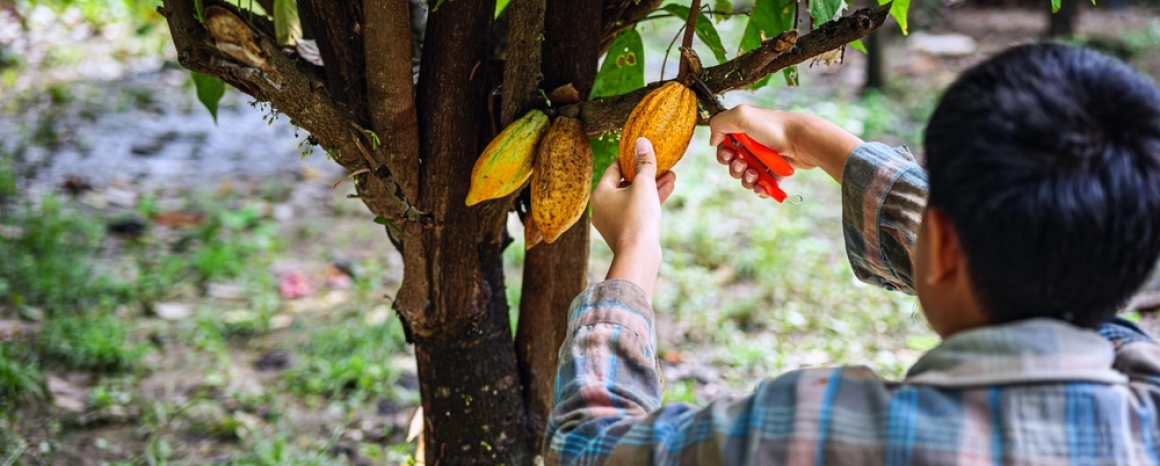
Cocoa — Forced labour and child labour are well-documented in cocoa supply chains in West Africa, particularly Côte d’Ivoire and Ghana. Chocolate from the Netherlands — as the world’s largest exporter of cocoa products and importer of cocoa beans from these origins — was added to the US Department of Labor’s list of goods produced with forced or child labour in 2024.
Fresh produce — Seasonal fresh produce supply chains — including tomatoes, strawberries, citrus, and salad crops — carry significant forced labour risk in sourcing regions including southern Italy, southern Spain, Morocco, and parts of the Americas. Mexico is cited in the 2024 DOL TVPRA List for forced labour in tomato farming, and ETI’s own investigations have documented exploitation linked to UK supermarket supply chains in Spanish and Italian salad and tomato production.
Seafood and fishing — Forced labour on fishing vessels is a persistent and particularly acute risk, partly because vessels operate in international waters beyond the reach of most labour inspection regimes. Debt bondage, violence, document retention, and extreme working conditions have been documented across Asia-Pacific fishing fleets. Indonesia, Thailand, and Taiwan have all featured in significant investigations. Reporting from Greenpeace informed the inclusion of fish from Taiwan on the DOL TVPRA list for a third time, revealing that Indonesian migrant workers continue to experience forced labour on distant water vessels.
Palm oil, tea, and other plantation crops — Plantation agriculture carries elevated risk wherever migrant workers are housed in employer-controlled accommodation, paid through non-transparent systems, or recruited through agencies charging fees. South and Southeast Asia are significant risk regions for tea, rubber, and palm oil.
The garment sector is among the most extensively documented for forced labour risk, driven by the combination of intense price competition, reliance on migrant and female labour, and complex, multi-tier supply chains with widespread subcontracting.
Garments are among the most frequently listed manufacturing goods on the US Department of Labor’s list of goods produced by forced or child labour. Key producing countries with documented risk include Bangladesh, India, Myanmar, Cambodia, Vietnam, and several others. Garments from Myanmar were added to the forced labour category (having previously appeared under child labour) in the 2024 DOL update, reflecting increased exploitation following the 2021 military coup. Garments from Mauritius were also newly flagged due to risks of foreign migrant workers being charged recruitment fees.
Garment production risk concentrates not in the branded Tier 1 factories — which are typically the most visible and most audited — but in the subcontracted cutting, trimming, and embellishment operations, in home-based piece-work, and in the spinning and yarn production that feeds the fabric supply chain. It is at these tiers that exploitation is most likely and least likely to be detected through standard audit approaches.
The UK, where significant garment production exists in Leicester and other cities, is not exempt: investigations have documented exploitation of migrant workers in domestic garment production linked to major retail brands.
Electronics supply chains carry forced labour risk across multiple product categories and at multiple tiers — from the raw material extraction that feeds component manufacturing to the assembly operations that produce finished goods.
Component assembly — Consumer electronics assembly, concentrated in China and Southeast Asia, has been subject to significant forced labour investigations. The Xinjiang forced labour context affects electronics supply chains through the solar polysilicon and aluminium sectors, as well as through labour transfer programmes in which workers from Xinjiang have been moved to factories elsewhere in China under conditions that may constitute forced labour.
Critical minerals and battery supply chains — This is an emerging and growing area of risk. The 2024 DOL TVPRA list added 12 critical minerals including cobalt, copper, and lithium — commodities that are central to the energy transition and whose supply chains are concentrated in a small number of countries with significant governance and labour rights challenges. Cobalt from the Democratic Republic of Congo, where artisanal and small-scale mining involves significant child labour and forced labour risk, is the most extensively documented. Lithium and copper from several South American and African countries also feature.
Solar supply chains — Polysilicon production, concentrated in Xinjiang, sits at the base of global solar panel supply chains. The UFLPA has driven significant scrutiny of solar supply chains, and companies sourcing solar components need to demonstrate they have traced their polysilicon supply beyond Chinese manufacturers to the specific production location.
Construction
Construction is one of the highest-risk sectors for forced labour globally, combining reliance on migrant labour, complex subcontracting chains, informal employment arrangements, and sector-specific vulnerability to debt bondage through recruitment fee systems.
Risk is particularly acute in contexts where large-scale construction is dependent on migrant workers recruited from South and Southeast Asia — the Gulf states, and specifically the Kafala system of tied employment that restricts workers’ ability to change employer or leave the country, has been extensively documented as a driver of forced labour. Qatar’s World Cup construction, the broader Gulf construction sector, and major infrastructure projects in parts of Asia and Eastern Europe all carry elevated risk.
Construction also carries significant forced labour risk in high-income countries, including the UK, where labour supply chains involving gangmasters and informal subcontractors have been associated with exploitation of migrant workers.
Domestic workers — employed in private homes as cleaners, carers, cooks, and child-minders — are among the world’s most vulnerable worker groups for forced labour. They work in private spaces, outside the scope of most labour inspection systems, often in an employment relationship with significant power imbalance, and frequently far from their communities and support networks.
Domestic servitude — where workers are confined to the home, have their documents retained, are paid little or nothing, and have no realistic ability to leave — is documented across the Middle East, Southeast Asia, Europe, and North America. Migrant domestic workers recruited through agencies in South and Southeast Asia to work in the Gulf, Lebanon, and elsewhere are at particularly high risk.
For companies, domestic work enters the risk picture primarily through cleaning, catering, hospitality, and care sector supply chains, as well as through the employment of domestic workers by employees in high-risk sourcing countries.
Service sector supply chains — cleaning contractors, security services, hospitality labour agencies, and logistics — carry significant forced labour risk in both high- and lower-income countries. These sectors rely heavily on low-wage, informal, and migrant labour, and are procured through competitive tender processes that drive suppliers toward minimum-cost labour arrangements.
In the UK, exploitation of migrant workers through cleaning and hospitality labour agencies has been well-documented. The Car Wash Code, developed with ETI’s involvement, emerged from investigations into widespread exploitation in hand car washing, a sector that had become almost entirely dependent on underpaid and often trafficked labour.
Forced labour risk is distributed globally — it is not confined to low-income countries, and high-income countries are not exempt. That said, certain regions carry disproportionate risk at scale, driven by the combination of sector concentration, governance conditions, and labour migration patterns.
The Asia-Pacific region accounts for the largest absolute number of people in forced labour, reflecting both population size and the concentration of global manufacturing. Key risk contexts include:
China — Xinjiang carries a distinct and extreme forced labour risk profile driven by state-imposed labour transfer programmes targeting Uyghur and other minority populations. Beyond Xinjiang, forced labour risk exists across multiple sectors and provinces, particularly in electronics, textiles, and construction, where migrant worker populations are significant. China continues to have the most goods on the US DOL TVPRA list.
South and Southeast Asia — Bangladesh, India, Myanmar, Cambodia, Vietnam, Thailand, Malaysia, and Indonesia all feature in documented forced labour supply chain risks across garments, electronics, seafood, palm oil, and construction. Migrant labour corridors within the region — workers from Myanmar, Cambodia, and Laos working in Thailand; workers from South Asia working in Malaysia and elsewhere — carry particular risk.
India — India features extensively in forced labour documentation across multiple sectors: garments (including fabric and yarn production), bricks, cotton, rice, and seafood. The country has the largest number of goods on the DOL TVPRA list of any single country. Bonded labour, particularly in agricultural and informal manufacturing contexts, is a significant and well-documented risk.
Agricultural supply chains — particularly cocoa, coffee, tobacco, and fresh produce — carry significant forced labour and child labour risk across multiple West, East, and Southern African countries. Artisanal and small-scale mining, including gold and cobalt, is a major risk area in the DRC and across the region’s critical minerals supply chains.
The Kafala system, which operates across Gulf Cooperation Council countries and Lebanon and Jordan, ties migrant workers to their employer as a condition of legal residence. Workers who leave an employer without permission lose their legal status, creating structural conditions for forced labour that are embedded in the legal framework of the host country. Reform of the Kafala system has progressed unevenly — Qatar made changes ahead of the 2022 World Cup, but implementation has been inconsistent.
State-imposed forced labour in cotton production in Uzbekistan was a longstanding documented risk that has improved significantly following sustained pressure by international brands and civil society — Uzbekistan has since been removed from the US ILAB TVPRA list for cotton. Turkmenistan continues to feature for state-imposed cotton labour. The region also carries significant risks through migrant labour corridors to Western Europe, particularly in agriculture, construction, and domestic work.
Forced labour risk in Latin America is concentrated in agriculture — sugarcane, coffee, soy, and tomatoes — and in mining. Brazil’s “dirty list” (Cadastro de Empregadores) is the most developed national mechanism for identifying and sanctioning employers found to use forced labour. Mexico features on the DOL TVPRA list for forced labour in tomato farming and child labour in sugarcane.
A common and dangerous misconception is that forced labour is only a risk in low-income or developing countries. Forced labour has been documented in the UK (garments, agriculture, car washing, domestic work, construction), the US (agriculture, domestic work, hospitality), Italy (garments, agricultural fresh produce) and Spain (agricultural fresh produce), and across Europe (seasonal agricultural labour).
The 2024 DOL TVPRA list added goods from the Netherlands — the first time a major Western European economy featured — reflecting the country’s role as an importer and processor of cocoa from high-risk origins. This is a useful reminder that forced labour risk in high-income countries can arise not just from direct production but from processing and re-export of goods with exploitative origins.
Sector and geography data is a starting point, not an answer. Several important principles should govern how it is applied:
Risk is dynamic, not static. The forced labour risk profile of a sector or country can change — as a result of new investigations, changes in political conditions, labour migration shifts, or enforcement actions. The US DOL TVPRA list, the UFLPA Entity List, and civil society investigations are continuously updated and should be monitored.
How you source matters as much as where. A company sourcing garments from Bangladesh through long-term relationships with established suppliers, with strong purchasing practices and good payment terms, faces a materially different risk profile from a company sourcing opportunistically through agents from the same country. Risk is shaped by the commercial relationship, not just the geography.
Sector risk does not predict worksite risk. A high-risk sector average does not mean every supplier in that sector is exploiting workers. Risk profiling identifies where to look; it does not replace the need to look.
Lower tiers carry higher risk. The parts of the supply chain with the highest forced labour risk are typically not the Tier 1 factories and farms that brands directly contract with. Risk concentrates in labour recruitment agencies, subcontractors, raw material producers, and processing operations that sit further from brand visibility.
Your own purchasing practices create risk. Excessive price pressure, short lead times, last-minute order changes, and payment delays push suppliers toward informal labour arrangements and subcontracting to facilities outside the scope of any due diligence programme. Risk assessment that focuses only on suppliers without examining the buyer’s own practices is incomplete.
Several external tools and databases are valuable for grounding sector and geography risk assessment:
US Department of Labor TVPRA List — The list currently covers 204 goods from 82 countries and areas, with the most common agricultural goods listed including sugarcane, cotton, coffee, tobacco, cattle, rice, and fish, and the most common manufacturing goods including bricks, garments, textiles, footwear, carpets, and fireworks. Updated every two years.
UFLPA Entity List — Maintained by the US Department of Homeland Security; identifies specific companies subject to the rebuttable presumption under the Uyghur Forced Labor Prevention Act. Updated regularly.
EU Forced Labour Regulation risk database — The European Commission is developing a geographic and product risk database to support EUFLR enforcement, to be published by June 2026 and accessible through the Forced Labour Single Portal.
US State Department Trafficking in Persons Report — Annual country-by-country assessment of anti-trafficking efforts, useful for understanding governance context in sourcing countries.
Verisk Maplecroft Human Rights Indices — Commercial dataset covering forced labour, child labour, and related risks by country and sector.
Walk Free Global Slavery Index — Country-level estimates of modern slavery prevalence and vulnerability, with analysis of governance and structural risk factors.
Does high-risk sector or geography designation mean forced labour is definitely present in my supply chain? No. Sector and geography data identifies where forced labour risk is most likely — where structural conditions make it more probable. It tells you where to prioritise your investigation, not what you will find. A supplier in a high-risk sector may have strong labour practices; a supplier in a lower-risk sector may have serious issues. Risk profiling should drive the depth and method of your due diligence, not replace it.
We source from a low-risk country. Do we still need to conduct forced labour due diligence? Yes. Forced labour risk is present in all countries, including high-income ones. More importantly, “country of manufacture” does not capture risks embedded in inputs that originate elsewhere — as the Netherlands cocoa example earlier in this page illustrates. A product manufactured in a low-risk country may contain raw materials or components with high-risk origins. Supply chain mapping beyond the final production stage is necessary to understand this exposure.
How do I stay current on changing risk profiles? The US DOL TVPRA list (updated every two years), the UFLPA Entity List (updated continuously), and the forthcoming EU Forced Labour Regulation risk database are the primary official sources. Civil society investigations — from organisations including Business & Human Rights Resource Centre, Walk Free, Anti-Slavery International, and sector-specific NGOs — often surface emerging risks ahead of official updates. Subscribing to monitoring services and maintaining active civil society engagement provides earlier warning of developing risk areas.
How do critical minerals fit into forced labour risk? Critical minerals — cobalt, lithium, copper, and others central to battery and energy transition supply chains — are an increasingly significant and rapidly growing area of forced labour risk. The 2024 DOL TVPRA list added 12 critical minerals, including cobalt, copper, and lithium. For companies with significant battery, electronics, or renewable energy supply chain exposure, critical minerals due diligence is becoming a regulatory priority as well as a reputational one.
Further reading in this cluster
What is modern slavery? Definitions, forms and scale
How to identify forced labour in your supply chain
Forced labour and migrant workers
EU Forced Labour Regulation: what it means for your business
Modern slavery legislation: what businesses need to know
Forced labour & modern slavery: a complete guide for business