Home

Main menu

  • About ETI
    • Our members
      • Public reporting performance
    • Who we are
      • ETI's origins
    • What we do
    • Global presence
    • Governance
    • Our team
      • ETI Board members
    • Our Strategy
  • Home
  • Why ETI
    • Why join ETI
  • ETI Base Code
    • Base Code overview
    • Base Code clause 1: Employment is freely chosen
    • Base Code clause 2: Freedom of association
    • Base Code clause 3: Working conditions are safe and hygienic
    • Base Code clause 4: Child labour shall not be used
    • Base Code clause 5: Living wages are paid
    • Base Code clause 6: Working hours are not excessive
    • Base Code clause 7: No discrimination is practiced
    • Base Code clause 8: Regular employment is provided
    • Base Code clause 9: No harsh or inhumane treatment is allowed
  • Our approach
    • Membership
    • Programmes
    • Transparency
    • Meaningful stakeholder engagement (MSE)
  • Our expertise
    • Climate change & Just transitions
    • Crisis response
    • Gender equity in supply chains
    • Worker representation
    • Forced labour & modern slavery
    • Responsible purchasing practices
      • RPP in manufacturing
    • Human rights due diligence
      • HRDD legislation tracker
  • Resources
    • Guidance & reports
    • Blog
      • Blog series: Extreme heat and risks to workers
      • Blog series: Tackling gender-based violence through GRACE
    • Issues
      • Human rights due diligence (HRDD): a complete guide for business
        • What is human rights due diligence?
        • Human rights due diligence legislation and regulatory requirements
        • How to implement human rights due diligence in your company
        • HRDD risk assessment for supply chains
        • Supplier engagement and human rights due diligence
      • Forced labour & modern slavery: a complete guide for business
        • What is modern slavery? Definitions, forms and scale
        • How to identify forced labour in your supply chain
        • Remediation: what to do when forced labour is found
        • Modern slavery legislation: what businesses need to know
        • EU Forced Labour Regulation: what it means for your business
        • How to write a modern slavery statement
        • High-risk sectors and sourcing regions for forced labour
        • Forced labour and migrant workers in supply chains
      • Responsible purchasing practices: what they are and why they matter
        • How to implement responsible purchasing practices
        • Responsible purchasing practices and legislation: what companies need to know
        • Responsible purchasing practices by sector
    • Case studies
    • Training
    • Events
      • ETI Insights series
    • Impact report 2024-25

Breadcrumb

  1. Home
  2. blog

11 years after the Tazreen Fashions fire: What's changed?

  • Share on Facebook
  • Share on Twitter
  • Share on LinkedIn
  • Taposh Barua - ETI Bangladesh
  • 24 November 2023
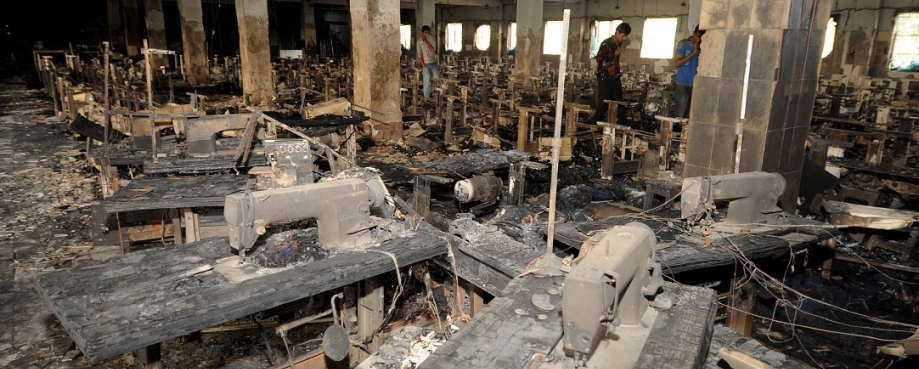
The Tazreen Fashions factory after the fire. Photo credit: Shutterstock.

Today marks the 11th anniversary of Tazreen Fashions fire, one of the worst industrial disasters in the history of Bangladesh. 

This incident exposed the inadequacy of occupational health and safety measures in Bangladesh’s ready-made garment (RMG) sector to the world. A reality confirmed in the most painful way, by the collapse of Rana Plaza, less than a year later.

The fire at Tazreen Fashions killed over 100 people and left many more injured, some of whom live with disabilities as a result. Last night, the injured, family members of the deceased, and workers’ rights activists, gathered at the site of the incident, for a candlelight vigil to remember and pay respects to those lost. 

Justice for survivors

The case of the Tazreen Fashions fire has still not been resolved in Bangladesh courts. Workers' rights activists have demanded a special tribunal for this case, to bring those responsible to account, seek treatment and rehabilitation support for the survivors, and secure financial support for the families of the deceased. 

A report by the Ministry of Home Affairs’ investigative committee stated that the fire was "clearly a crime of causing death by negligence" and recommended "prosecution under section 304 (a) of the penal code". All evidence pointed to gross negligence from the owners and management of Tazreen Fashions, in ensuring the safety of workers.

Never again

The Tazreen fire shook the sector, from suppliers, civil society, trade unions and government bodies in Bangladesh, to brands, retailers, multi-stakeholder initiatives (MSIs), trade unions and consumers worldwide. Commentary highlighted the need for more accountability to ensure the safety and security of the sector’s workers. Despite the global outcry that followed, Rana Plaza collapsed a mere four months later. 

Rana Plaza triggered industry-wide collaboration and practical action to ensure a safer and secure workplace in Bangladesh’s RMG industry. The ACCORD and Alliance were established to support and monitor these issues. The ACCORD, which later became RMG Sustainability Council, provides training, auditing, and grievance support in the sector. The efforts of MSIs, civil society, business associations, buyers and suppliers resulted in substantive improvements across the industry, but there remains much more to do. 

Driving progress on occupational health and safety

Resolving these issues across global supply chains will take a journey of continuous improvement. In Bangladesh, training on occupational health and safety issues, implementation of local labour law, oversight from government inspection bodies and monitoring from the buyers’ side are crucial. Support from civil society and MSIs can play a critical role in this journey. 

Building the appropriate facilities, training, and dialogue for and between workers and management is paramount. In both cases, at Tazreen Fashions and Rana Plaza, it was observed that workers’ concerns about health and safety were not heard before the disasters occurred. If management and factory owners had engaged with worker's concerns, huge loss of life could have been avoided.

ETI began work in Bangladesh shortly after these two disastrous events. We found that beyond facilities, there is a definite need for worker's participation and workplace dialogue to wipe out, or at least to reduce such events in the future. ETI’s flagship social dialogue programme has successfully identified and resolved workplace risks through dialogue in more than a hundred factories in Bangladesh. Alongside this work, ETI Bangladesh delivers regular occupational health and safety training in factories across Dhaka. 

Visit the ETI Bangladesh website for more on our work protecting workers’ rights across the country.  

ETI's blog covers issues at the intersection of business and human rights. We feature posts by, for and from our members and allies; we do not accept or offer payment for posts or publish content outside of these criteria. We welcome a range of insights and opinions from our guest bloggers, though don't necessarily agree with everything they say.

Stay up to date

Stay up to date with the latest from ETI via the following channels:
  • Email
  • Twitter
  • LinkedIn
  • Blog RSS

Get the latest

Subscribe to our email newsletters and stay up to speed on responsible business.

Subscribe

ETI elsewhere

  • Twitter
  • LinkedIn
  • YouTube

Footer

  • ETI Community
  • Accessibility
  • Contact
  • FAQ
  • Jobs at ETI
  • Press resources
  • Security & privacy
Other ETIs: Bangladesh, Denmark, Norway, Sweden
Ethical Trading Initiative | Registered No. 3578127