Get the latest
Subscribe to our email newsletters and stay up to speed on responsible business.

Climate action is accelerating. Governments, businesses and investors are looking to circular economy models, cleaner production and green industries as part of the transition to a more sustainable future. But what kind of work is being created in this transition?
At COP30, countries agreed to establish a Just Transition Mechanism. This has been welcomed as an opportunity to move from broad commitments to more practical action, including better coordination, technical assistance, and knowledge sharing. This matters because a just transition is not only about reducing emissions or pollution. It is also about ensuring that the people working in these supply chains have safe, fair, dignified jobs.
Lessons from the Sustainable Manufacturing and Environmental Pollution (SMEP) Programme help show what this means in practice. SMEP was established to address the environmental and human health impacts of manufacturing in sub-Saharan Africa and South Asia, working with businesses, NGOs and universities across sectors including plastics, organic waste, textiles and apparel, tanneries and leather, and used lead acid batteries. ETI has worked with SMEP grantees to strengthen safeguarding practices and decent work approaches, including through training, practical tools, risk assessment support and peer learning. Through this collaboration, SMEP has generated practical learning on how environmental programmes can support safer, fairer and more inclusive work, particularly in supply chains involving small and medium-sized enterprises and workers in informal employment. These experiences show how environmental goals and decent work goals can be integrated.
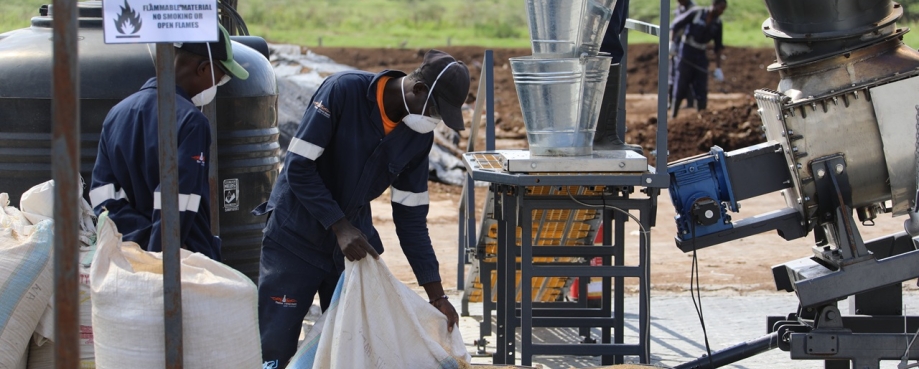
Contributing to environmental goals does not automatically mean a supply chain is good for workers. Circular supply chains and green industries can still involve hazardous materials, heavy machinery, dust, chemical runoff, sharp tools, repetitive tasks and heat stress. Some risks are visible, others are less so, especially those faced by women, migrant workers and workers with low literacy. In newer circular economy sectors, many hazards are still not fully understood.
There are also wider decent work challenges. Many circular supply chains rely on low-paid work, informal employment and workers who have limited access to contracts, social protection or representation. Globally, 52% of circular economy employment is informal.
Decent work cannot be treated as an add-on. Businesses, partner organisations and funders need to build decent work into environmental initiatives from the start.
One of the biggest lessons from our work with SMEP grantees is that progress often starts with practical, visible improvements. Micro, small and medium-sized enterprises (MSMEs) make up the majority of businesses globally and account for 60 to 70% of employment, but many face tight margins, limited capacity and barriers to investment. Decent work interventions need to identify the right leverage points for business action, linking improvements in working conditions to clearer benefits for business performance. Occupational health and safety (OHS) is generally a good starting point. Workers and managers can often see the benefits quickly: fewer injuries, fewer sick days, better morale and less workplace tension.
Risk assessment should not be a tick-box exercise completed by management alone. Workers know the realities of their jobs best. Tools such as body mapping, hazard mapping and joint safety inspections can help identify risks that can easily be missed by those not doing the job.
Mananasi Fibre in Kenya shows what this can look like in practice. The company produces fibre from pineapple waste and employs around 106 workers. Through SMEP and ETI support, it introduced worker-led body mapping to identify areas of physical strain, moved from shared to individualised personal protective equipment, and introduced practical welfare measures, including a dedicated bus that also provides shelter and first aid support in remote locations. By adjusting how loads were managed, the business reduced physical strain on workers and improved overall productivity; a clear example of how practical decent work improvements can also support business performance.
This is an example of a practical change that workers can see and feel in their daily lives, and not just a policy commitment.
Informal work is the dominant form of employment globally, engaging around 2 billion workers, close to 60% of the global workforce. In many low- and middle-income countries this rises to 80 to 90%. Many of these workers are already part of supply chains linked to environmental goals. Formalisation, as per ILO Recommendations 204, can improve working conditions, but it must be approached carefully. Workers may fear that formalisation will reduce their take-home pay or increase tax obligations. For migrant workers in particular, greater visibility to authorities can raise concerns, especially where documentation, status or trust in formal systems is uncertain.
The goal is decent work, not formalisation for its own sake. This means understanding workers’ priorities, protecting their lives and livelihoods, and addressing the most harmful forms of informal work. In practice, it means improving health and safety, supporting access to social protection, strengthening worker voice and working closely with local organisations that understand and respond to the context.
The just transition mechanism agreed at COP30 creates an opportunity to strengthen international cooperation. However, for just transition actions to stay true to the real meaning of the term, global commitments must connect with the realities of workers and businesses. As climate and environmental action speeds up, the question is not only whether green and circular industries can grow, but whether they can grow in a way that respects workers’ rights, improves livelihoods and strengthens workers’ voice, agency, and representation. For ETI, this also means recognising freedom of association as an essential part of just transition, even where organising, representation and unionisation remain difficult in practice. The workers powering the green economy deserve no less.
Drawing on lessons from the Sustainable Manufacturing and Environmental Pollution (SMEP) Programme, this webinar explores to integrate decent work and occupational health and safety into environmental initiatives and emerging green supply chains in practice.
About the SMEP Programme
The Sustainable Manufacturing and Environmental Pollution (SMEP) Programme is funded by UK International Development and implemented in partnership with UN Trade and Development (UNCTAD), who provide technical support. UK International Development has appointed a Project Management Agent (PMA) to manage programme delivery. The PMA comprises a consortium partnership between Pegasys and SouthSouthNorth.