Home

Main menu

  • Home
  • Why ETI
    • Why join ETI
  • ETI Base Code
    • Base Code overview
    • Base Code clause 1: Employment is freely chosen
    • Base Code clause 2: Freedom of association
    • Base Code clause 3: Working conditions are safe and hygienic
    • Base Code clause 4: Child labour shall not be used
    • Base Code clause 5: Living wages are paid
    • Base Code clause 6: Working hours are not excessive
    • Base Code clause 7: No discrimination is practiced
    • Base Code clause 8: Regular employment is provided
    • Base Code clause 9: No harsh or inhumane treatment is allowed
  • Our approach
    • Membership
    • Programmes
    • Transparency
    • Meaningful stakeholder engagement (MSE)
  • Our expertise
    • Climate change & Just transitions
    • Crisis response
    • Gender equity in supply chains
    • Worker representation
    • Forced labour & modern slavery
    • Responsible purchasing practices
      • RPP in manufacturing
    • Human rights due diligence
      • HRDD legislation tracker
  • Resources
    • Guidance & reports
    • Blog
      • Blog series: Tackling gender-based violence through GRACE
    • Case studies
    • Training
    • Events
      • ETI Insights series
    • Impact report 2024-25
  • About ETI
    • Who we are
      • ETI's origins
    • What we do
    • Our members
      • Public reporting performance
    • Global presence
    • Governance
    • Our Strategy
    • Our team
      • ETI Board members

Breadcrumb

  1. Home
  2. blog

The crisis of workers' rights is now a crisis of democracy: Responsible business cannot look away

  • Share on Facebook
  • Share on Twitter
  • Share on LinkedIn
  • Luc Triangle
  • 8 June 2026
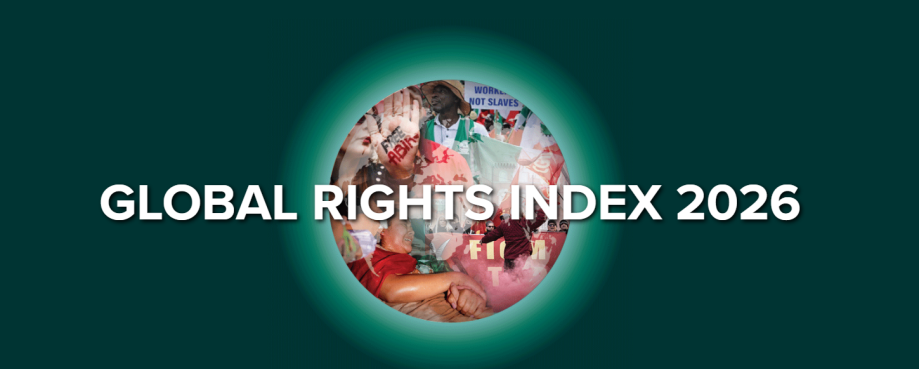
Photo credit: ITUC Global Rights Index 2026.

For many years, violations of workers’ rights were often viewed as a problem confined to authoritarian regimes or fragile states. The findings of the 2026 ITUC Global Rights Index tell a different story.

The erosion of workers’ rights is no longer taking place at the margins of the global economy. It is increasingly happening in countries that have long presented themselves as democratic and stable.

This should concern all of us.

The 2026 Index reveals a world in which workers are finding it harder to organise, harder to make their voices heard and harder to access justice when their rights are violated:

  • Europe and the Americas have both recorded their worst average ratings since the Index began in 2014.
  • The United States has been added to the Watchlist amid concerns over restrictions on collective bargaining and the use of force against workers.
  • France has been downgraded to its lowest-ever rating in the Index.
  • Argentina has experienced one of the steepest declines ever recorded, falling from a rating of 3 to 5 in just two years and entering the list of the ten worst countries in the world for workers.

These developments are significant not simply because of what they say about labour rights. They are important because of what they reveal about the health of our democracies.

The Index documents:

  • A record 72% of countries restricting workers’ access to justice.
  • Half of all countries arrested or detained workers for exercising their rights.
  • Violent attacks on workers increased by 6% compared with the previous year.
  • Attacks on freedom of speech and assembly reached record levels.

Behind every statistic is a worker who has been intimidated, silenced or punished for seeking a voice at work. Behind every violation is an attempt to weaken one of the most important democratic institutions in society: the trade union movement.

What is particularly striking in this year’s findings is that repression is evolving. While violence and arrests remain a reality in many countries, governments and employers are increasingly relying on more sophisticated methods to limit workers’ collective power.

  • Trade union leaders are being targeted through criminalisation, legal harassment and politically motivated prosecutions.
  • Digital technologies are being used to monitor workers and undermine organising efforts.
  • In many countries, governments are simply bypassing social dialogue, consulting trade unions less frequently when developing labour legislation or major economic reforms.

These practices may appear less visible than police raids or mass arrests, but their impact can be just as damaging. When workers lose the ability to organise freely and engage in meaningful collective bargaining, they lose one of the most effective mechanisms for defending fair wages, safe workplaces and equal treatment.

This matters not only for workers and trade unions. It matters for responsible businesses as well.

For decades, social dialogue has been recognised as a cornerstone of sustainable economic development. Strong industrial relations help identify risks, resolve disputes and build trust. Independent trade unions are often the first to expose unsafe working conditions, labour abuses and human rights violations within supply chains.

When workers cannot speak freely, problems do not disappear. They become harder to detect and harder to address.

At a time when companies are facing growing expectations around human rights due diligence and responsible business conduct, the ability of workers to organise and bargain collectively is more important than ever. Businesses committed to ethical trade should recognise trade unions not as obstacles, but as essential partners in creating resilient, productive and sustainable workplaces.

The good news is that decline is not inevitable.

This year’s Index also shows that progress is possible when governments, employers and workers engage constructively. Botswana and the United Kingdom improved their ratings from 4 to 3, while Uruguay joined the small group of countries achieving the highest rating of 1.

These improvements remind us that workers’ rights are ultimately shaped by political choices and institutional commitments. Governments can strengthen labour protections. Employers can respect freedom of association and collective bargaining. International institutions can uphold labour standards. And consumers and investors can continue to demand accountability throughout global supply chains.

The lessons of the 2026 ITUC Global Rights Index are clear. The weakening of workers’ rights is not a narrow workplace issue; it is a warning sign for democracy itself. When workers are denied a voice, democratic participation is weakened. When trade unions are marginalised, accountability suffers. And when rights are treated as obstacles rather than foundations, both societies and economies become more fragile.

Trade unions remain the largest democratic movement in the world. Every day, workers continue to organise, negotiate and defend the principles of fairness, dignity and inclusion.

Their struggle is not separate from the struggle for democracy; it is an essential part of it.

Protecting workers’ rights is therefore not only a matter of justice. It is an investment in stronger democracies, more responsible businesses and a more sustainable future for all.

ETI's blog covers issues at the intersection of business and human rights. We feature posts by, for and from our members and allies; we do not accept or offer payment for posts or publish content outside of these criteria. We welcome a range of insights and opinions from our guest bloggers, though don't necessarily agree with everything they say.

Stay up to date

Stay up to date with the latest from ETI via the following channels:
  • Email
  • Twitter
  • LinkedIn
  • Blog RSS

Get the latest

Subscribe to our email newsletters and stay up to speed on responsible business.

Subscribe

ETI elsewhere

  • Twitter
  • LinkedIn
  • YouTube

Footer

  • ETI Community
  • Accessibility
  • Contact
  • FAQ
  • Jobs at ETI
  • Press resources
  • Security & privacy
Other ETIs: Bangladesh, Denmark, Norway, Sweden
Ethical Trading Initiative | Registered No. 3578127