Home

Main menu

  • About ETI
    • Our members
      • Public reporting performance
    • Who we are
      • ETI's origins
    • What we do
    • Global presence
    • Governance
    • Our team
      • ETI Board members
    • Our Strategy
  • Home
  • Why ETI
    • Why join ETI
  • ETI Base Code
    • Base Code overview
    • Base Code clause 1: Employment is freely chosen
    • Base Code clause 2: Freedom of association
    • Base Code clause 3: Working conditions are safe and hygienic
    • Base Code clause 4: Child labour shall not be used
    • Base Code clause 5: Living wages are paid
    • Base Code clause 6: Working hours are not excessive
    • Base Code clause 7: No discrimination is practiced
    • Base Code clause 8: Regular employment is provided
    • Base Code clause 9: No harsh or inhumane treatment is allowed
  • Our approach
    • Membership
    • Programmes
    • Transparency
    • Meaningful stakeholder engagement (MSE)
  • Our expertise
    • Climate change & Just transitions
    • Crisis response
    • Gender equity in supply chains
    • Worker representation
    • Forced labour & modern slavery
    • Responsible purchasing practices
      • RPP in manufacturing
    • Human rights due diligence
      • HRDD legislation tracker
  • Resources
    • Guidance & reports
    • Blog
      • Blog series: Extreme heat and risks to workers
      • Blog series: Tackling gender-based violence through GRACE
    • Issues
      • Human rights due diligence (HRDD): a complete guide for business
        • What is human rights due diligence?
        • Human rights due diligence legislation and regulatory requirements
        • How to implement human rights due diligence in your company
        • HRDD risk assessment for supply chains
        • Supplier engagement and human rights due diligence
      • Forced labour & modern slavery: a complete guide for business
        • What is modern slavery? Definitions, forms and scale
        • How to identify forced labour in your supply chain
        • Remediation: what to do when forced labour is found
        • Modern slavery legislation: what businesses need to know
        • EU Forced Labour Regulation: what it means for your business
        • How to write a modern slavery statement
        • High-risk sectors and sourcing regions for forced labour
        • Forced labour and migrant workers in supply chains
      • Responsible purchasing practices: what they are and why they matter
        • How to implement responsible purchasing practices
        • Responsible purchasing practices and legislation: what companies need to know
        • Responsible purchasing practices by sector
      • UK mandatory human rights due diligence: what businesses need to know
    • Case studies
    • Training
    • Events
      • ETI Insights series
    • Impact report 2024-25

Breadcrumb

  1. Home
  2. blog

Selfridges joins ETI

  • Share on Facebook
  • Share on Twitter
  • Share on LinkedIn
  • Alexandra Moat-Rowe - Selfridges
  • 9 July 2024
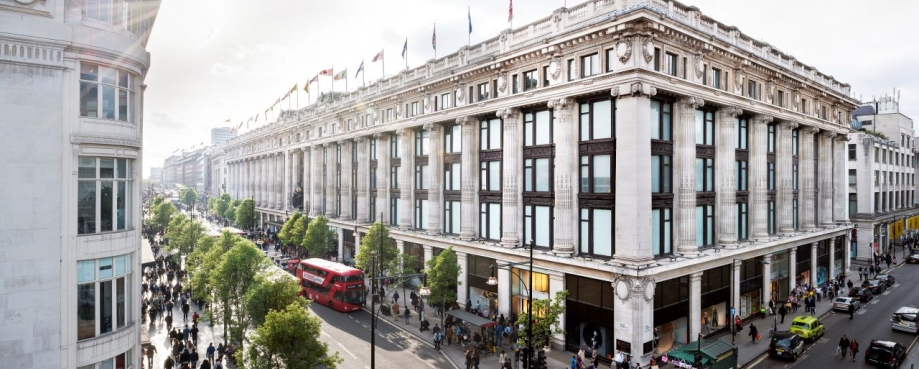
Selfridges Oxford Street Corner Shot Oxford Street & Duke Street. Photo Credit: Andrew Meredith/Selfridges.

Selfridges was founded by Harry Gordon Selfridge, changing the world of retail forever when the first store opened on Oxford Street in 1909. Since then, we have opened three more stores in Manchester and Birmingham and become the only store to be named Best Department Store in the World four times.  

A landmark destination and social centre where everyone is welcome, Selfridges is powered by imagination and filled with creative spirit. From our in-house cinema, restaurants, bars, and skate bowl to an ever-evolving roster of collaborators and cultural partnerships, Selfridges is a creative playground in which to discover new ideas and live brighter. 

At Selfridges we are committed to creating a more sustainable future for people and planet and continue to build on over a decade of retail activism. 

We were amongst the first to ban the sale of fur, exotic skins, plastic-based cosmetic glitter, and single-use plastic bottles, converted to using 100% renewable electricity in our stores and offices, and made our iconic yellow carrier bags plastic-free.

We launched Project Ocean in 2011 as a campaign to protect oceans from overfishing and plastic pollution, followed by Project Earth in 2020 which included ambitious long-term sustainability commitments set to radically change our business. Today, our Reselfridges initiative brings circular shopping to the forefront, with rental, repair, pre-owned, and refill services available in permanent destinations across all four Selfridges stores.

Named Retailer of the Year at the inaugural Positive Luxury Awards 2020, our business continues to pursue ambitious targets, explore new business models, and challenge the mindsets of partners and customers, with a goal of achieving net-zero carbon emissions by 2040. 

In 2024, Selfridges created a dedicated Responsible Sourcing Team within our Sustainability and Innovation Department.  Since this evolution, the team have been busy establishing the groundwork across the business’s pillars of ethical trade: Embedding Standards, Proactively Investigating, and Raising Awareness. 

My team's work has spanned across creating and reviewing policies, risk-analysis, staff training, and direct engagement with suppliers and brand partners. But I know there is much more to be done, and so does our Head of Sustainability and Innovation, Ella Gould: 

“Our Responsible Sourcing Team has a clear brief: to understand how we can source more responsibly across all areas of the business. Who better to help us achieve that, than ETI?

We are thrilled to be part of such an important initiative and share ETI’s vision of a world that provides opportunity whilst protecting human rights and dignity. ETI membership will facilitate real advancement in our own due diligence work, and we very much welcome the opportunity to learn from, and align with, fellow ETI member companies and retailers, and engage with ETI’s network of trade unions and NGOs. We hope to go further and faster, with the guidance and insights the ETI community has to offer.”

Interested in becoming an ETI member? Contact membership@eti.org.uk to fine out more about how to join ETI.

ETI's blog covers issues at the intersection of business and human rights. We feature posts by, for and from our members and allies; we do not accept or offer payment for posts or publish content outside of these criteria. We welcome a range of insights and opinions from our guest bloggers, though don't necessarily agree with everything they say.

Stay up to date

Stay up to date with the latest from ETI via the following channels:
  • Email
  • Twitter
  • LinkedIn
  • Blog RSS

Get the latest

Subscribe to our email newsletters and stay up to speed on responsible business.

Subscribe

ETI elsewhere

  • Twitter
  • LinkedIn
  • YouTube

Footer

  • ETI Community
  • Accessibility
  • Contact
  • FAQ
  • Jobs at ETI
  • Press resources
  • Security & privacy
Other ETIs: Bangladesh, Denmark, Norway, Sweden
Ethical Trading Initiative | Registered No. 3578127