Get the latest
Subscribe to our email newsletters and stay up to speed on responsible business.

A new PhD research partnership between Northumbria University’s Centre
for Global Development, the Ethical Trading Initiative and Women Working
Worldwide explores gender just transitions in global food supply chains.
We are excited to announce a new research project focused on enhancing gender just transitions in global food supply chains. This research will be conducted by doctoral student Aishath Green at the Centre for Global Development (Northumbria University), in partnership with Ethical Trading Initiative (ETI) and Women Working Worldwide (WWW). The impetus for this research emerged from ETI’s work on promoting just transitions in the food, farming and fisheries sector through an emphasis on social dialogue between workers, communities, trade unions, companies and civil society and WWW’s focus on assisting and empowering women workers in global supply chains to enhance their rights.
As climate change impacts intensify across the globe, there has been increased attention towards just transitions in policy, practice and research. At its core, just transitions call for a socially just departure from fossil fuels towards low-carbon societies, with the ILO defining it as “greening the economy in a way that is as fair and inclusive as possible to everyone concerned, creating decent work opportunities and leaving no one behind”. However, in practice, the concept remains ambiguous with understandings varying “widely across regions, sectors and social groups”. As such, we still have much to learn about what just transitions mean, how they can be achieved, and what kinds of impacts they will have on different communities.
While much of the existing research on just transitions has focused on the energy sector, food systems have received less attention. Yet, as a sector both heavily impacted by climate change and a significant contributor to greenhouse gas emissions (accounting for roughly 12% globally) it is vital that we understand how to navigate this tension in a socially just way. As researchers have already highlighted “[a] food system can move towards reducing carbon emissions and even deforestation; however, it can remain unequal in other dimensions”. This means thinking about climate mitigation in the context of wider social justice issues that take into consideration diverse knowledge practices, historical injustices and systems that perpetuate unequal power relations. This research project will build upon work already conducted by ETI and WWW to further understanding of what just transitions could look like for those working across global agricultural supply chains.
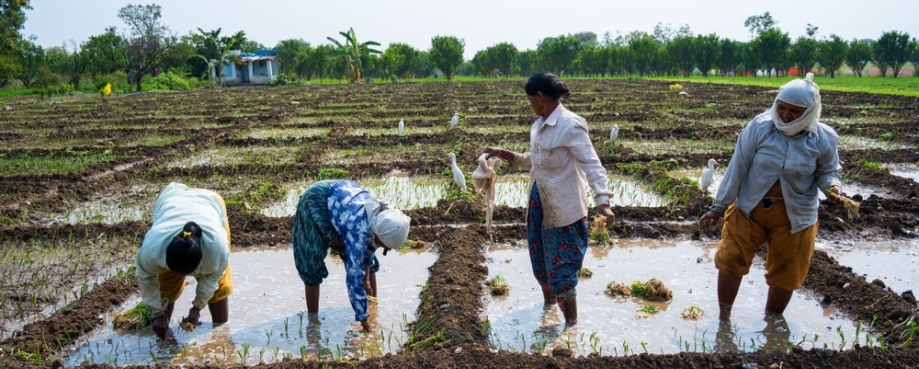
Women workers are integral to global food supply chains (36% of working women globally work in agri-food systems), yet they are significantly underrepresented in decision-making spaces discussing the future of their livelihoods. As conversations around just transitions develop, it is imperative that their voices are integrated to reflect the diversity of women’s experiences and the impacts that policies may have on them. Steps taken to increase sustainable agricultural practices, for example, have been shown to have detrimental impacts on women by increasing their workload. To navigate this complexity, this research seeks to explore how social dialogue with, and collective organising by women workers can help platform their specific needs across global commodity supply chains. Women workers have a long history of successful collective organising to improve their working conditions and research shows that within agri-food systems this can be an effective way to address the structural barriers they face. This collective organising includes formal avenues such as trade union structures but also incorporates informal action that takes place in spaces in which women feel able to articulate their concerns. As ETI and WWW have demonstrated through their ‘Safe Spaces’ report, these can include women’s homes and local community settings but also vary from context to context depending on where women feel safe to speak about issues important to them. This project aims to explore the diverse ways in which women are collectively organising and how it can contribute to both understanding and achieving gender just transitions.
Over the next three years, this research will adopt a multi-scalar approach, engaging with actors across global agricultural supply chains. This includes working directly with women workers, and companies in the global south, as well as UK corporate stakeholders to understand how gender just transitions can be equitably achieved. Specifically, the research will ask:
Funded by the Arts and Humanities Research Council through the Northern Bridge
Consortium, this project will employ interdisciplinary and creative methods including oral history interviews, archival research and participatory photography. This approach seeks to ensure women are active participants in the research and creates the space for insights informed by both historical injustices and women’s everyday experiences connecting longer histories of labour organising with contemporary climate challenges. As part of this collaborative partnership, the findings from this research will be shared with ETI’s and WWW’s audiences through a series of blogs and policy briefs over the course of the three-year project.
Aishath Green is a researcher working at the intersection of climate justice, gender equality and labour rights. Before starting her PhD at Northumbria University’s Centre for Global Development, she worked as a Research Associate at University College London on a UKRI-funded project examining how politics shapes global measurement frameworks for climate adaptation. With an academic background in History from the University of Edinburgh and Environment, Politics and Development from SOAS, Aishath brings an interdisciplinary and feminist perspective to questions of social and environmental justice. Having previously explored street traders’ right to the city, she is particularly interested in how women workers’ collective action can inform just climate transitions in global food systems. Aishath comes at this project from a knowledge of practice and looks forward to using creative and participatory methods to bridge research and policy through this collaboration.
ETI is a leading alliance of trade unions, NGOs and companies, working together to advance human rights in global supply chains. Just Transitions is a strategic priority for ETI. The organisation focuses on sectors that are both highly vulnerable to climate change and significant contributors to GHG emissions and environmental impacts, but which to date have received less attention than sectors such as energy. Social dialogue is at the heart of ETI’s approach: workers are both rightsholders and sources of knowledge and expertise on how the world of work is changing in the era of climate crisis. WWW is a charity that works in partnership with grassroots organisations and Unions around the world, to assist and empower women workers in global supply chains to claim their rights and gain decent wages for their work. The organisation works with companies to advocate on behalf of women workers, and to advise companies on how best to meet their commitments to gender equality and women’s rights across their supply chains. WWW recognises that work in global supply chains such as garments, horticulture and flowers offer vital opportunities for women to earn a living, provide for their families and improve their social and economic standing. The project is jointly supervised by Prof Katy Jenkins, co-director of the Centre for Global Development, alongside Dr Sarah Peck and Dr Paul Griffin. Together, the team bring combined expertise in women’s activism and collective organising, labour geographies, and historical geographies, alongside experience of undertaking research with women’s organisations, civil society organisations, and trade unions across a range of contexts.
This blog was originally published by Northumbria University, Newcastle.