Get the latest
Subscribe to our email newsletters and stay up to speed on responsible business.


Do we want a pic? Caption here is optional
This resource is a product of the RPP Learning and Implementation Community (LIC), a group of 36 garment brands from Europe and the UK. The community met online every two months for two years (2022-2024), to engage with manufacturers, learn from each other, and take action to improve purchasing practices.
Video clips from live workshops, practical tools, and case studies have now been collated into this resource hub. Structured around the principles of the Common Framework for Responsible Purchasing Practices, it aims to support more businesses to improve their impact on supply chain partners and workers.
The LIC was brought together by the Ethical Trading Initiative, FairWear, Ethical Trade Norway, the German Partnership for Sustainable Textiles (PST) and Solidaridad., and in close partnership with the Sustainable Terms of Trade Initiative.
The LIC was funded by the Initiative for Global Solidarity (IGS) implemented by Deutsche Gesellschaft für Internationale Zusammenarbeit (GIZ) GmbH (supported by the German Federal Ministry for Economic Cooperation and Development) and the Sustainable Textile Initiative: Together for Change (STITCH) (supported by the Dutch Government). The RPP resource hub is supported by the same two funders.

Random example of logos
Need to write this bit…. And include links, logos etc.
Improving purchasing practices needs a collaborative approach. Whilst the actions of individual buyers can have a significant impact, these actions are influenced by wider systems.
Industry status quo, company strategy, and decisions by a range of functions, such as legal and finance, all inform and shape buyer-supplier dynamics. At the same time, impacts on suppliers and workers may not be obvious. It’s important to work together, engaging with relevant functions and suppliers to understand the realities of day-to-day practice, identify potential problems, and work collaboratively to explore solutions.
In this video, Hilary explains the key steps to take, to understand the impact your practices could be having on suppliers and workers, and to work together to improve. Use this resource hub to support each step of your journey.
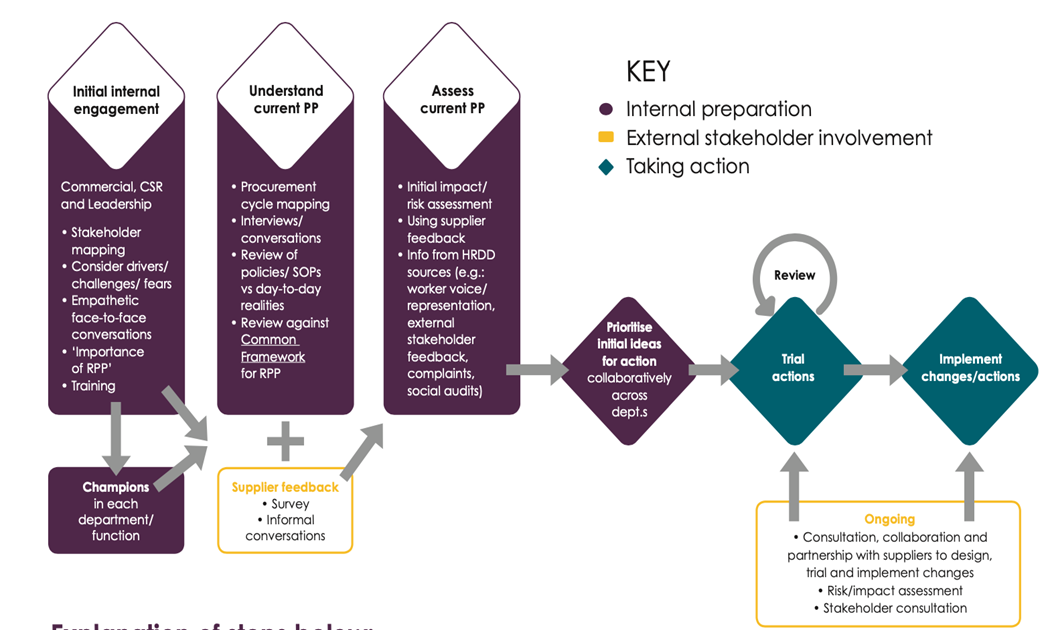
This is an 'expandable image' - click to expand. Caption is optional
The steps Design note: make this list a collapsible box? We also have a pdf version of this diagram and steps. Include a button to download the pdf.
This resource hub is structured around the five principles of the Common Framework for Responsible Purchasing Practices (CFRPP).
The CFRPP provides a shared language on responsible purchasing, through five core principles. These principles support you to engage with stakeholders and take practical action to create an enabling environment for good labour standards in your supply chains.

In order to implement changes to purchasing practices, the company has top leadership buy-in and commitment; has a thorough understanding of existing suppliers and purchasing systems and (possible) negative impact on human rights; and uses this to decide on priorities that feed into anagreed improvement plan. responsible purchasing practices are integrated into the commercial and other relevant departments of a business. This includes integrating purchasing practices into strategy and decision making processes; and establishing external reporting, internal KPIs/accountability and training.

The purchasing company and their suppliers respect each other as equal business partners; engage in respectful sourcing dialogue; and pursue win-win situations, with a shared responsibility to improve working conditions. This includes building long-term, secure sourcing relationships; reducing the churn of suppliers; formulating agreements on mutual responsibilitiesfor responsible purchasing; only using force majeure clauses responsibly; improving communication; achieving partnership in problem solving andemploying responsible exit strategies.

Critical path and production planning is done collaboratively between the purchasing company and suppliers. Any changes are mutually agreed and cannot be detrimental to the supplier. This includes reducing samples; providing accurate tech packs; increasing forecasting accuracy; balancing orders; tracking reasons for delay in thecritical path; and the purchaser taking responsibility for delays caused by missed deadlines on their part.

The purchasing company and suppliers agree on fair and transparent payment terms that include all relevant information regarding the payment pro-cedure and do not place a disproportionate burden on one party. Contractual obligations are honoured at all times. Payments are made in full & on time.
This includes ensuring payments are made on time; aiming to improve the timeline of payment; and mutually agreeing reasonable penalties, takinginto account the cause of any delay in delivery.

The costing procedures and levels of the purchasing company reflect and support wage increases and sustainable production. Prices cover all costsof production in line with responsible business conduct and allow for a reasonable and maintained supplier profit margin. This includes developing mechanisms to ensure costing allows for all labour costs and increases when labour costs increase (through national minimumwages and/or collective bargaining); and implementing a costing strategy that supports increased wages to reach a living wage.
The five principles of the CFRPP are applicable across the apparel and footwear industry. Frameworks have also been developed for the food sector and wider manufacturing industry. (Add links). Under each principle are suggested practices for you to implement and build upon, to establish responsible practices within your own business.
However, just as there are many different types of brands, retailers, products and suppliers, there are many different ways to do business. Practices that work well within one context may create undue pressure in another. It is essential to engage with your suppliers to find practices that work within your operational context, ensuring you work together to create decent conditions for the workers in your supply chains.
Groundwork and progress practices:
For each principle, the practices are presented in two stages, groundwork and progress practices. This supports a gradual, staged implementation, whatever your starting point.
Text boxes with authors of the framework, and guidance on how to use it for new product areas.
Many different factors influence supply chain conditions, and a range of approaches are needed to understand and prevent risks to the people working in them. Whilst responsible purchasing practices are just one piece of a bigger puzzle, they are essential for any business committed to respecting the human rights of the people involved in making and supplying their products.
In this video, Fatima-Zohra Alaoui, General Manager of the Moroccan Association of Textile and Apparel Industries (AMITH), highlights, from manufacturers’ perspective, the urgency for change to industry practice.
Whilst not just a ‘nice-to-have’ responsible practices can bring significant benefits to purchasing companies.
Companies that take the time to engage with their internal teams, across functions, and with their suppliers, to review and improve their ways of working, consistently report improvements such as better relationships, efficiency, problem-solving and even supply chain transparency. (Can we include feedback from the LIC to evidence these points? Otherwise, we might have some feedback from the RPP in manufacturing that can evidence them)
In this video, Stevie-Lee Bird, Production Manager at Hobbs (TFG London), talks through some of the key changes Hobbs made as a result of participating in the LIC, and explains the benefits of making these changes.
Companies have a moral and legal obligation to respect and protect human rights, in the context of their business activities.
The UN Guiding Principles on Business and Human Rights and the OECD Guidelines on Responsible Business Conduct, set out clear expectations for responsible business. Companies have a responsibility to engage with stakeholders to understand how their business activities may be linked to human rights risks and to take corrective action to prevent these risks. This includes consideration and improvement of their own purchasing practices.
As the links between purchasing practices and human rights risks are increasingly well understood, this expectation is becoming more explicit and is being written into legislation. The European Corporate Sustainability Due Diligence Directive (CSDDD) emphasises that businesses must review their own operations as part of their due diligence, explicitly stating that purchasing practices and strategies should not contribute to adverse impacts.
As you engage with your leadership teams and other functions in your company, it may be helpful to understand how the legislative landscape is changing and use this to encourage your company to keep ahead of the curve.
This resource, developed by ETI, provides a deep dive on how the CSDDD sets out expectations when it comes to responsible purchasing. It emphasises how the CFRPP can serve as a reference tool to help meet these requirements. Whilst written for the CFRPP for manufacturing industries (adapted to be less sector-specific than the original CFRPP), the principles are still easily recognisable for the garment and footwear sector.
Holding companies accountable for their purchasing practices, through legislation and other accountability mechanisms, is important to push progress and create a level playing field for responsible business. In order for these mechanisms to work, there needs to be a clear shared understanding of the key activities companies should be held accountable for.
Whilst it is agreed that companies must review their own purchasing practices as part of their HRDD, there needs to be a clear shared understanding of what this means in practice. Authored by the Responsible Purchasing Practices Working Group, the Purchasing Practices HRDD Framework is a recommendation to policy makers, regulators, multistakeholder initiatives, and investors on the key actions companies should be held accountable for, when it comes to responsible purchasing. This framework:
This resource hub compliments the Purchasing Practices HRDD Framework, guiding you through practical steps to engage with stakeholders, assess risk and make improvements. But whilst this resource hub is intended to give you ideas and tips, and (as with the CFRPP) gives you the flexibility to adapt these ideas to suit your own operational context, the Purchasing Practices HRDD Framework focuses in on core requirements for which companies should be held accountable.
You can read the full framework, including how the requirements relate to the Common Framework for Responsible Purchasing Practices and the OECD due diligence steps.
© Ethical Trading Initiative. All rights reserved. Content may not be reproduced without prior permission of ETI. Contact eti@eti.org.uk.