Get the latest
Subscribe to our email newsletters and stay up to speed on responsible business.

Ten years ago, women made up 80% of garment workers in Bangladesh. Now the number is reportedly closer to 60%. Why are women dropping out of the garment workforce in Bangladesh? What explains approximately half a million women slipping out of the sector?
Part of the answer is the rise of automation. In Bangladesh, industry experts refer to the change as happening slowly, with a long fuse. We hear from factory managers we work with that increased automation is becoming a reality in many of their critical production processes -- one of which is cutting operations. Whereas a few years ago factories had teams of workers cutting fabric to be passed on to sewing operators and ultimately sewn into garments, now that human labour has been replaced with machines.
Around 20 workers, most of them women, have been replaced with an automated cutting machine and two to three workers, most of them men. These shifts, while small in the context of one factory, have massive implications for the industry, for women’s job opportunities, skills development, employment in production countries, and more. Studies suggest that in the garment industry and many others, the production of key goods could look radically different in coming years. Lower-skilled workers will be replaced by machines able to conduct repetitive tasks, and eventually much of the production line process will be automated and able to execute decisions autonomously with minimal oversight from higher-skilled workers. One study suggests nearly 60 percent of garment workers in Bangladesh will become unemployed by 2030.
How do we make sure vulnerable workers, especially women, are not left behind in the context of these enormous transitions on the horizon? How do workers prepare for the future world of work?
A recent report Keeping Workers in the Loop, from colleagues at BSR explores the social and job impacts of a major shift to circular fashion. It considers the shift to circular fashion alongside other macro industry trends such as automation and climate disruption. The report highlights skills which will be critical for future jobs, such as increased agility, flexibility, tolerance for ambiguity, problem-solving, learning ability, and digital skills. This means workers in global supply chains with a combination of soft skills and technical digital skills will best positioned for future world of work.
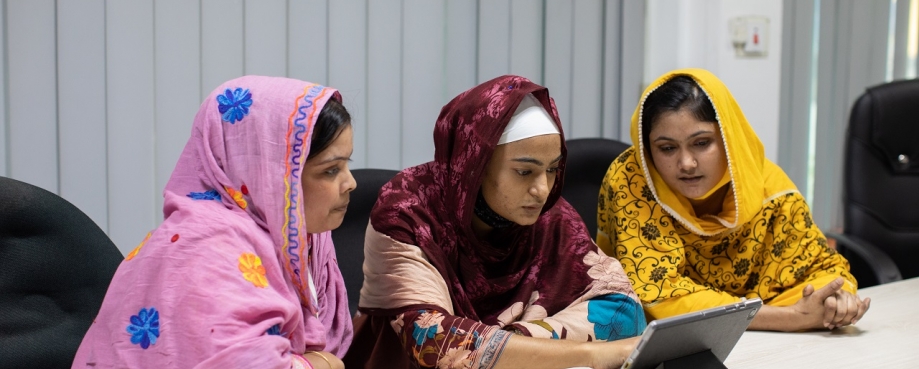
At HERproject we have started initial testing to understand how we can support women workers during the next digital transformation. HERproject has fifteen years of experience supporting workers in areas such as gender equality, health, financial inclusion, and prevention of violence. To begin addressing the digital capabilities gap, we developed HERessentials, a digital worker and management learning programme that uses a tablet-based app as part of training. We are currently piloting the app in countries in Latin America, as well as in Bangladesh, Pakistan, and India, and will soon expand to Vietnam and Cambodia. The app focuses on building worker and manager knowledge on topics such as hygiene and general health, reproductive health, financial services and planning, stress management, and workplace cooperation as well as improving digital skills. This was an early test to support digital capability building for workers and managers.
Through our piloting we heard promising initial feedback from workers, suppliers, local NGO implementors, and brands; they told us that workers find the tablet interface engaging during training sessions and an incentive to participate in the training. They’ve seen cases where workers have improved their confidence using a digital interface - for example women that at the beginning felt shy using the tablet have now grown in confidence. This may be a starting point for a more comprehensive approach to building women workers’ digital capabilities.
Our piloting of HERessentials and broader experience with HERproject suggests that skills are just part of the equation. Most often the barriers that keep women back in the workplace are not skills but about a lack of space and support for women to advance professionally. For example, an absence of women in leadership positions is often less to do with skills female employees possess and more about confidence and creating an enabling environment in the workplace. Taking a gender sensitive management approach and addressing the full spectrum of barriers that women face in the workplace will be even more critical as workplaces undergo significant digital transformations in the years to come.
Workplaces in supply chains will be more digitalised in the years to come – and vulnerable workers are most at risk of being left behind. An investment is required to make sure that workers are equipped with a combination of soft and digital skills in preparation for the future world of work. As technology evolves, so too will skills requirements, and any upskilling will need to be designed to adapt and flex for the inevitable change ahead. At HERproject, we are in the early stages of testing models that apply a gender lens to workers’ digital skills building. Our ambition is to collaborate with partners, suppliers, and workers, to build a full programme that supports this critical transition.
Please get in touch if you are interested in getting involved.