Home

Main menu

  • About ETI
    • Our members
      • Public reporting performance
    • Who we are
      • ETI's origins
    • What we do
    • Global presence
    • Governance
    • Our team
      • ETI Board members
    • Our Strategy
  • Home
  • Why ETI
    • Why join ETI
  • ETI Base Code
    • Base Code overview
    • Base Code clause 1: Employment is freely chosen
    • Base Code clause 2: Freedom of association
    • Base Code clause 3: Working conditions are safe and hygienic
    • Base Code clause 4: Child labour shall not be used
    • Base Code clause 5: Living wages are paid
    • Base Code clause 6: Working hours are not excessive
    • Base Code clause 7: No discrimination is practiced
    • Base Code clause 8: Regular employment is provided
    • Base Code clause 9: No harsh or inhumane treatment is allowed
  • Our approach
    • Membership
    • Programmes
    • Transparency
    • Meaningful stakeholder engagement (MSE)
  • Our expertise
    • Climate change & Just transitions
    • Crisis response
    • Gender equity in supply chains
    • Worker representation
    • Forced labour & modern slavery
    • Responsible purchasing practices
      • RPP in manufacturing
    • Human rights due diligence
      • HRDD legislation tracker
  • Resources
    • Guidance & reports
    • Blog
      • Blog series: Extreme heat and risks to workers
      • Blog series: Tackling gender-based violence through GRACE
    • Issues
      • Human rights due diligence (HRDD): a complete guide for business
        • What is human rights due diligence?
        • Human rights due diligence legislation and regulatory requirements
        • How to implement human rights due diligence in your company
        • HRDD risk assessment for supply chains
        • Supplier engagement and human rights due diligence
      • Forced labour & modern slavery: a complete guide for business
        • What is modern slavery? Definitions, forms and scale
        • How to identify forced labour in your supply chain
        • Remediation: what to do when forced labour is found
        • Modern slavery legislation: what businesses need to know
        • EU Forced Labour Regulation: what it means for your business
        • How to write a modern slavery statement
        • High-risk sectors and sourcing regions for forced labour
        • Forced labour and migrant workers in supply chains
      • Responsible purchasing practices: what they are and why they matter
        • How to implement responsible purchasing practices
        • Responsible purchasing practices and legislation: what companies need to know
        • Responsible purchasing practices by sector
    • Case studies
    • Training
    • Events
      • ETI Insights series
    • Impact report 2024-25

Breadcrumb

  1. Home
  2. blog

How Covid-19 has left one Rana Plaza workers' initiative fighting for survival

  • Share on Facebook
  • Share on Twitter
  • Share on LinkedIn
  • Lindsay Wright - ETI
  • 18 May 2020

In this guest blog, Jay Kerr of NoSweat describes how Oporajeo, a worker-owned  garment factory set up in the aftermath of the Rana Plaza Disaster, is being supported to survive COVID-19  

Covid-19 has had a devastating impact on the garment industry in Bangladesh as a million workers are facing unemployment due to the loss of orders from major brands, as the world went into lockdown.

One factory struggling to survive is a worker-owned factory set up by survivors of Rana Plaza and activists involved in the rescue efforts.

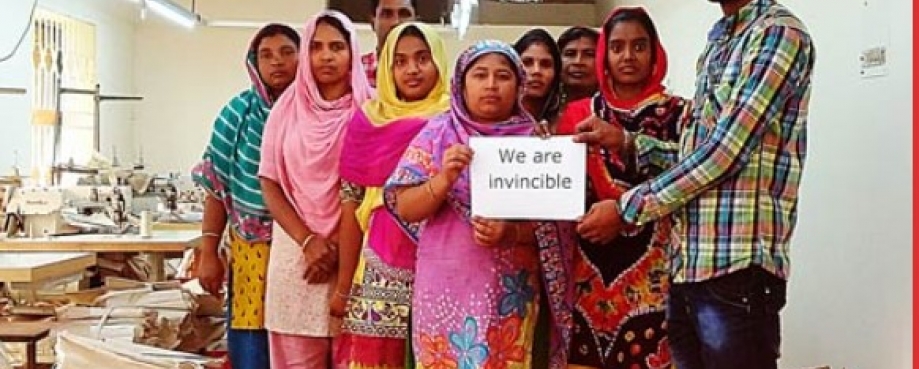
Out of the crisis that hit when the Rana Plaza factory complex collapsed, tragically killing 1,138 people, came this symbol of hope and survival. Oporajeo, which means "invincible" in Bengali, provided a new life for a group of garment workers, gave them a say in their own work and ensured that the pay they earned was enough for a decent life. 

Over the past 7 years Oporajeo has faced many challenges, but has lived up to its name by coming through them, and growing into a factory of 95 workers, earning higher than the national minimum and having a democratic voice in their work. 

For the past few years Oporajeo has been working with No Sweat, a British anti-sweatshop campaign group that began producing its own brand of “T-shirts that fight sweatshops” in 2017. Made by Oporajeo and sold for wholesale in the UK by No Sweat to bands, trade unions and campaign groups, these T-shirts have been raising funds to support No Sweat’s campaign against exploitation in the garment industry. 

One of the founders of Oporajeo, Kazi Monir Hossain, has said: “All of us at Oporajeo are equal. We are workers and we make our decisions together, ensuring we all benefit. Making clothes for No Sweat means our work can help other garment workers fight for their rights and share the benefits.”

But, the impact of the global coronavirus pandemic has led to No Sweat and Oporajeo to suspend T-shirt production and instead focus on the relief efforts in Dhaka, feeding families of garment workers left without an income during Bangladesh’s lockdown. As the factories now begin to reopen there are fears for the health and safety of workers in this densely populated country. Factories need to implement social distancing measures that will lead to fewer workers being able to work safely in production workshops, when the orders from brands around the world eventually begin to return. 

No Sweat is working with Oporajeo to face the future together and ensure that this initiative, born out of one tragedy in 2013, doesn’t succumb to another - the global Covid-19 crisis of 2020.

ETI's blog covers issues at the intersection of business and human rights. We feature posts by, for and from our members and allies; we do not accept or offer payment for posts or publish content outside of these criteria. We welcome a range of insights and opinions from our guest bloggers, though don't necessarily agree with everything they say.

Stay up to date

Stay up to date with the latest from ETI via the following channels:
  • Email
  • Twitter
  • LinkedIn
  • Blog RSS

Related content

  • Vulnerable employment is on the rise
  • Italian tomatoes: no more excuses over labour exploitation
  • One in a million - or why are UK employers getting away with third world conditions?
  • Labour rights in Cambodia - reflections and questions
  • Myanmar MSI Public Statement
  • Gender inequality in international supply chains

Get the latest

Subscribe to our email newsletters and stay up to speed on responsible business.
Subscribe

ETI elsewhere

  • Twitter
  • LinkedIn
  • YouTube

Footer

  • ETI Community
  • Accessibility
  • Contact
  • FAQ
  • Jobs at ETI
  • Press resources
  • Security & privacy
Other ETIs: Bangladesh, Denmark, Norway, Sweden
Ethical Trading Initiative | Registered No. 3578127