Home

Main menu

  • About ETI
    • Our members
      • Public reporting performance
    • Who we are
      • ETI's origins
    • What we do
    • Global presence
    • Governance
    • Our team
      • ETI Board members
    • Our Strategy
  • Home
  • Why ETI
    • Why join ETI
  • ETI Base Code
    • Base Code overview
    • Base Code clause 1: Employment is freely chosen
    • Base Code clause 2: Freedom of association
    • Base Code clause 3: Working conditions are safe and hygienic
    • Base Code clause 4: Child labour shall not be used
    • Base Code clause 5: Living wages are paid
    • Base Code clause 6: Working hours are not excessive
    • Base Code clause 7: No discrimination is practiced
    • Base Code clause 8: Regular employment is provided
    • Base Code clause 9: No harsh or inhumane treatment is allowed
  • Our approach
    • Membership
    • Programmes
    • Transparency
    • Meaningful stakeholder engagement (MSE)
  • Our expertise
    • Climate change & Just transitions
    • Crisis response
    • Gender equity in supply chains
    • Worker representation
    • Forced labour & modern slavery
    • Responsible purchasing practices
      • RPP in manufacturing
    • Human rights due diligence
      • HRDD legislation tracker
  • Resources
    • Guidance & reports
    • Blog
      • Blog series: Extreme heat and risks to workers
      • Blog series: Tackling gender-based violence through GRACE
    • Issues
      • Human rights due diligence (HRDD): a complete guide for business
        • What is human rights due diligence?
        • Human rights due diligence legislation and regulatory requirements
        • How to implement human rights due diligence in your company
        • HRDD risk assessment for supply chains
        • Supplier engagement and human rights due diligence
      • Forced labour & modern slavery: a complete guide for business
        • What is modern slavery? Definitions, forms and scale
        • How to identify forced labour in your supply chain
        • Remediation: what to do when forced labour is found
        • Modern slavery legislation: what businesses need to know
        • EU Forced Labour Regulation: what it means for your business
        • How to write a modern slavery statement
        • High-risk sectors and sourcing regions for forced labour
        • Forced labour and migrant workers in supply chains
      • Responsible purchasing practices: what they are and why they matter
        • How to implement responsible purchasing practices
        • Responsible purchasing practices and legislation: what companies need to know
        • Responsible purchasing practices by sector
    • Case studies
    • Training
    • Events
      • ETI Insights series
    • Impact report 2024-25

Breadcrumb

  1. Home
  2. blog

Increased violence as minimum wage protests intensify in Bangladesh

  • Share on Facebook
  • Share on Twitter
  • Share on LinkedIn
  • ETI
  • 31 October 2023
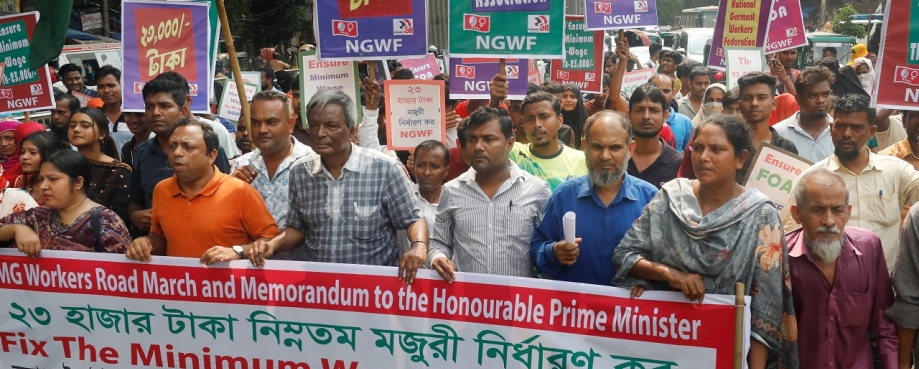
The National Garment Workers Federation marched and held a rally in Dhaka's Shahbag demanding a minimum wage of monthly BDT 23,000 for garment workers. Photo credit: Shutterstock.

ETI is deeply concerned by the increased violence reported in recent protests and demonstrations in Bangladesh, as garment workers take to the streets to demand a minimum wage increase.

We are troubled by news of the death of Rasel Howlader yesterday during the protests, Mr. Howlader worked at the Design Express factory. Amirul Islam, a worker at Columbia Garments, was also injured during yesterday’s events in Gazipur. Both worked for unionised factories affiliated with Sommilito Garments Sramik Federation (SGSF). Today, violence continues with news that a 32-year-old man has died in a factory fire reportedly set by a mob in Gazipur.

We have also received reports that workers and trade union leaders are being arrested during the demonstrations. We call on all parties to refrain from violence and damaging private property and to stop anti-union discrimination against workers.

ETI supports the legitimate demands of workers and local unions for increases in the minimum wage which is currently well below inflation and the rising cost of living. Any increase should be absorbed through appropriate cost-burden sharing between buyers and suppliers.

The Bangladesh wage board should act promptly and transparently to finalise its deliberations in line with the real needs of workers.

ETI Executive Director, Peter McAllister said

“Workers have the right to demand a higher minimum wage. Wages and benefits should always be enough to meet basic needs and to provide some discretionary income. The current wage of around £60 a month does not do this. ETI joins calls for a living wage, and one that is set through a collaborative, inclusive process that avoids any form of violence.”    

ETI's blog covers issues at the intersection of business and human rights. We feature posts by, for and from our members and allies; we do not accept or offer payment for posts or publish content outside of these criteria. We welcome a range of insights and opinions from our guest bloggers, though don't necessarily agree with everything they say.

Stay up to date

Stay up to date with the latest from ETI via the following channels:
  • Email
  • Twitter
  • LinkedIn
  • Blog RSS

Get the latest

Subscribe to our email newsletters and stay up to speed on responsible business.
Subscribe

ETI elsewhere

  • Twitter
  • LinkedIn
  • YouTube

Footer

  • ETI Community
  • Accessibility
  • Contact
  • FAQ
  • Jobs at ETI
  • Press resources
  • Security & privacy
Other ETIs: Bangladesh, Denmark, Norway, Sweden
Ethical Trading Initiative | Registered No. 3578127