Home

Main menu

  • About ETI
    • Our members
      • Public reporting performance
    • Who we are
      • ETI's origins
    • What we do
    • Global presence
    • Governance
    • Our team
      • ETI Board members
    • Our Strategy
  • Home
  • Why ETI
    • Why join ETI
  • ETI Base Code
    • Base Code overview
    • Base Code clause 1: Employment is freely chosen
    • Base Code clause 2: Freedom of association
    • Base Code clause 3: Working conditions are safe and hygienic
    • Base Code clause 4: Child labour shall not be used
    • Base Code clause 5: Living wages are paid
    • Base Code clause 6: Working hours are not excessive
    • Base Code clause 7: No discrimination is practiced
    • Base Code clause 8: Regular employment is provided
    • Base Code clause 9: No harsh or inhumane treatment is allowed
  • Our approach
    • Membership
    • Programmes
    • Transparency
    • Meaningful stakeholder engagement (MSE)
  • Our expertise
    • Climate change & Just transitions
    • Crisis response
    • Gender equity in supply chains
    • Worker representation
    • Forced labour & modern slavery
    • Responsible purchasing practices
      • RPP in manufacturing
    • Human rights due diligence
      • HRDD legislation tracker
  • Resources
    • Guidance & reports
    • Blog
      • Blog series: Extreme heat and risks to workers
      • Blog series: Tackling gender-based violence through GRACE
    • Issues
      • Human rights due diligence (HRDD): a complete guide for business
        • What is human rights due diligence?
        • Human rights due diligence legislation and regulatory requirements
        • How to implement human rights due diligence in your company
        • HRDD risk assessment for supply chains
        • Supplier engagement and human rights due diligence
      • Forced labour & modern slavery: a complete guide for business
        • What is modern slavery? Definitions, forms and scale
        • How to identify forced labour in your supply chain
        • Remediation: what to do when forced labour is found
        • Modern slavery legislation: what businesses need to know
        • EU Forced Labour Regulation: what it means for your business
        • How to write a modern slavery statement
        • High-risk sectors and sourcing regions for forced labour
        • Forced labour and migrant workers in supply chains
      • Responsible purchasing practices: what they are and why they matter
        • How to implement responsible purchasing practices
        • Responsible purchasing practices and legislation: what companies need to know
        • Responsible purchasing practices by sector
    • Case studies
    • Training
    • Events
      • ETI Insights series
    • Impact report 2024-25

Breadcrumb

  1. Home
  2. blog

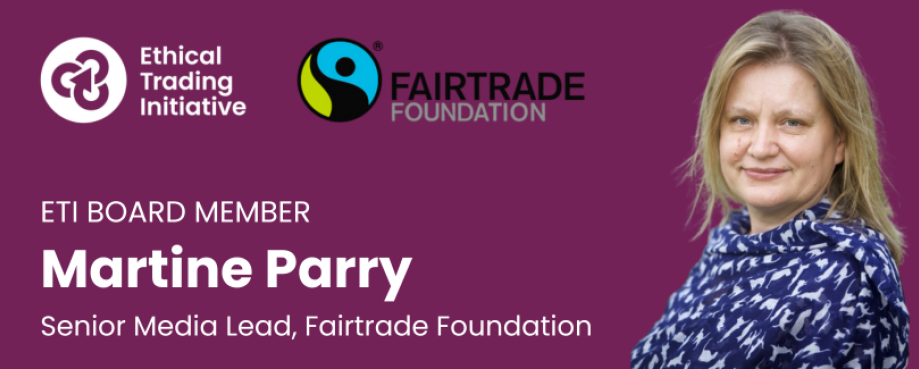
Martine Parry joins ETI Board as Non-Executive Director

  • Share on Facebook
  • Share on Twitter
  • Share on LinkedIn
  • ETI
  • 30 September 2025
Martine Parry

Martine Parry, Senior Media Lead at the Fairtrade Foundation, has been appointed as a Non-Executive Director to the Board of the Ethical Trading Initiative (ETI), with her tenure beginning 25 September 2025.  

ETI is a leading authority on human rights due diligence, and has spent over 25 years bringing together companies, trade unions, and NGOs to advance human rights issues in global supply chains. As scrutiny of supply chain abuses intensifies and growing legislative pressure on businesses, ETI’s role is more vital than ever. 

“I’m very pleased to be joining ETI’s Board and I look forward to contributing to advancing workers’ rights and driving meaningful change across global supply chains,” 

Martine Parry said.  

“ETI’s unique tripartite model offers a powerful platform for collaboration and impact by bringing together the businesses, trade unions and NGOs to solve some of the biggest issues across value chains”. 

Martine joins as NGO representative to ETI’s tripartite board — governed by an equal number company, trade union and NGO representatives, alongside one staff representative and a Board Chair. Martine brings her experience in media, advocacy and campaigning at the Fairtrade Foundation, Fashion Revolution and the former Disability Rights Commission to help shape ETI’s strategic direction. She plays an active role in ETI’s NGO Caucus, representing Fairtrade in efforts to influence corporate behaviour and uphold workers’ rights, ensuring alignment with the mission, strategy, and programmes of both organisations.

The Fairtrade Foundation, a long-standing ETI member and independent non-profit, represents over two million farmers and workers worldwide. It owns the FAIRTRADE Mark, a trusted sustainability label found on more than 6,000 UK products. Through partnerships with businesses, engagement with consumers, and support for producers, Fairtrade drives a fairer, more sustainable future rooted in social justice. 

Martine is a seasoned strategic communications professional with a track record of leading award-winning, high-impact PR and integrated campaigns across global sectors. Her expertise spans sustainability, supply chains, international development, and both consumer and business communications. 

ETI's blog covers issues at the intersection of business and human rights. We feature posts by, for and from our members and allies; we do not accept or offer payment for posts or publish content outside of these criteria. We welcome a range of insights and opinions from our guest bloggers, though don't necessarily agree with everything they say.

Stay up to date

Stay up to date with the latest from ETI via the following channels:
  • Email
  • Twitter
  • LinkedIn
  • Blog RSS

Get the latest

Subscribe to our email newsletters and stay up to speed on responsible business.

Subscribe

ETI elsewhere

  • Twitter
  • LinkedIn
  • YouTube

Footer

  • ETI Community
  • Accessibility
  • Contact
  • FAQ
  • Jobs at ETI
  • Press resources
  • Security & privacy
Other ETIs: Bangladesh, Denmark, Norway, Sweden
Ethical Trading Initiative | Registered No. 3578127