Get the latest
Subscribe to our email newsletters and stay up to speed on responsible business.

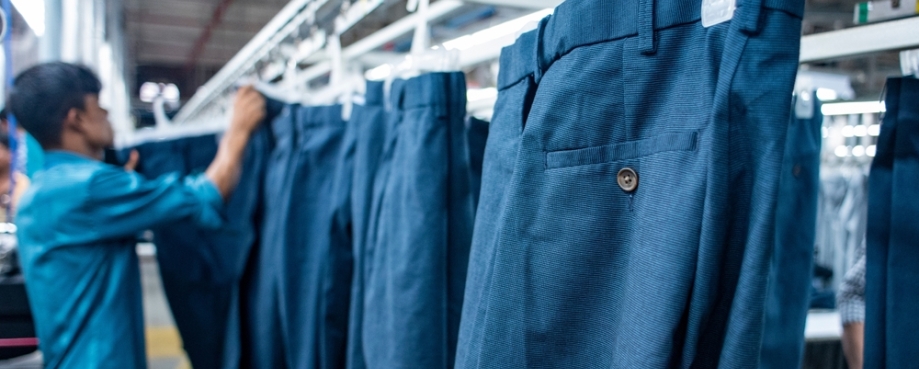
The new Public Eye and Clean Clothes Campaign report provides a detailed analysis of how sourcing prices for basic garments have eroded over the past two decades. It documents how, despite rising global costs, “in real terms, buyers are paying 30% less than 25 years ago” and how this long‑term compression of value has shaped sourcing geographies, buyer behaviour and working conditions.
The report’s analysis makes clear that pricing cannot be separated from the conditions needed to deliver on sustainability commitments. The report offers a valuable and detailed contribution to this debate. The scenarios it presents are illustrative rather than prescriptive, and applying them will surface real complexity across different products, sourcing contexts and supplier relationships. ETI welcomes the findings as a contribution to an ongoing conversation about what responsible production actually costs.
This opens an opportunity for a more realistic conversation about what kind of sourcing model can support those commitments in practice.
The report does not prescribe a new model. But its evidence highlights a structural issue: when prices remain below the real cost of production, the space for progress on wages, safety and environmental performance becomes extremely limited. This is not a matter of intention or commitment, it reflects the underlying business model the industry has come to rely on.
The opportunity here is a practical one: the findings create space for the fashion industry to look honestly at how value is distributed today and what would be needed to make sustainability commitments achievable moving forward. This is not wishful thinking. The evidence creates a real opening for change, if the sector chooses to use it.
At the same time, ETI’s work with brands and suppliers makes clear that implementation challenges are real and must be named plainly. Brands competing on tight margins face limits on unilateral price shifts, particularly where buying teams are incentivised to prioritise cost. Suppliers likewise operate within narrow financial thresholds between buyer demands and factory viability. These dynamics do not absolve responsibility, they simply define the terrain that any credible path forward must confront.
The report looks at a standard cotton T‑shirt and breaks down what it costs to produce it right up to the point it is handed over for free on board shipping (FOB). Instead of starting from a target price and negotiating down, the price is built from the real cost of responsible production.
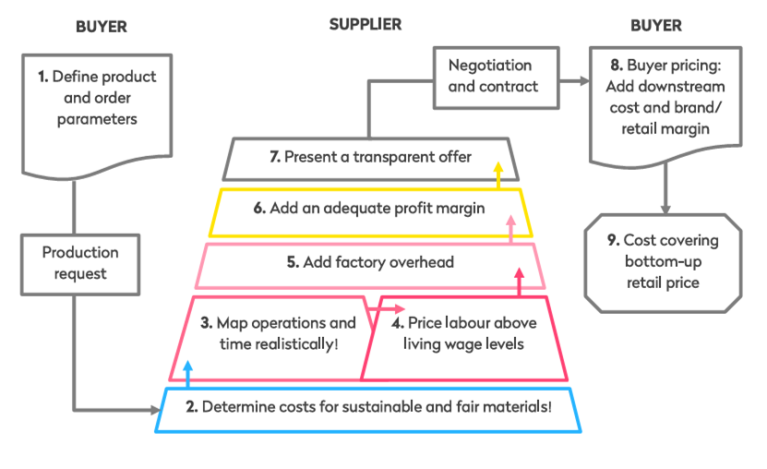
Figure 1: Bottom-up pricing. Source: Public Eye / Clean Clothes Campaign, 'Squeezed Dry', May 2026 (Figure 16 in original report).
It models two examples:
In both cases, labour costs rise, materials cost more when they are produced sustainably, and factory running costs increase to reflect safer and more ergonomic workplaces. The result is a higher FOB price: around USD 3.00 in the first scenario and USD 5.00 in the second, compared with a typical USD 2.00 baseline.
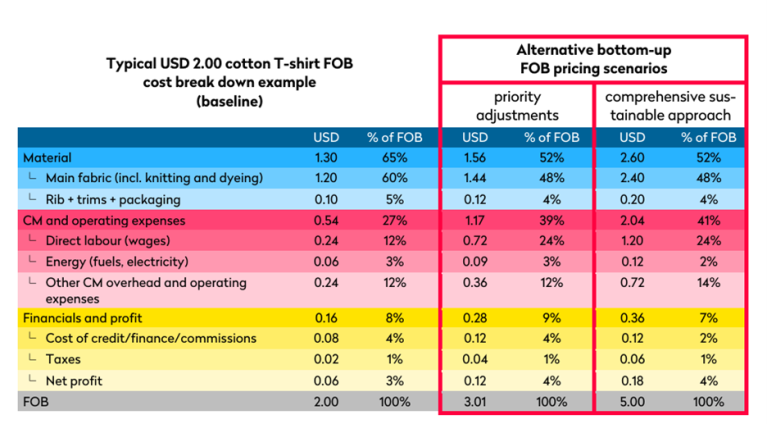
Figure 2: Cost breakdown: Shifting from squeezed to sustainable bottom-up FOB pricing. Source: Public Eye / Clean Clothes Campaign, 'Squeezed Dry: Pricing pressure in the global fashion industry', May 2026 (Box 3 in original report).
These figures are illustrative, not prescriptive, and can be challenging to apply consistently across different products, suppliers and contexts. Actual prices will vary by product and supplier, but the examples do help clarify what it would take to align pricing with living wages, safe work and credible environmental performance. They also highlight a constructive opportunity. Now that we understand the real cost structure, the industry can move beyond marginal adjustments and explore pricing approaches that genuinely support its sustainability commitments.
The report also notes that supportive regulation — on purchasing practices, unfair trading and due diligence — would help level the playing field so that responsible suppliers are not undercut. This includes the Purchasing Practices HRDD Framework,[1] which sets out clear expectations for integrating purchasing practices into human rights due diligence. ETI has been closely involved in developing this agenda , through our Responsible Purchasing Practices programme and the Common Framework, which provide companies with practical tools to understand how purchasing decisions shape conditions in supply chains. While it does not offer pricing guidance or costing tools, it provides a shared reference point for what responsible purchasing should look like, an important foundation for more transparent and fair pricing.
The report also explores the idea of minimum price targets, benchmarks that signal the price level below which purchasing should not fall. As the report puts it, a minimum price target is ‘a normative orientation benchmark that signals the expected price level below which purchasing should not fall’.
Minimum price targets can help address situations where market dynamics drive prices below the cost of responsible production. The report notes that such interventions are uncommon in market‑based economies, but not unprecedented, pointing, for example, to Spain’s ban[2] on purchasing agricultural products below‑cost production.
For cotton T‑shirts, the report proposes two indicative benchmarks:
These thresholds are not prescriptions. They are tools to help companies assess risk. As the report explains, prices below USD 12/kg fall into an ‘extreme risk zone’ for under‑pricing, while prices above USD 30/kg indicate a reduced risk.
Minimum price targets can be integrated into human rights due diligence systems to flag when purchasing practices may be contributing to wage suppression, excessive overtime or environmental non‑compliance. They can also guide buying teams by establishing a pricing corridor and requiring justification when prices fall below agreed thresholds.
Experience from working with brands and suppliers points to where the real friction lies: costing conversations that lack transparency, buying processes that sideline the people who understand production realities, and supplier relationships that are too transactional to sustain the trust these changes demand.
The report emphasises that minimum price is not a standalone solution. These examples also underline that pricing approaches only work when embedded in a wider shift toward more predictable, fair and transparent purchasing practices. As the report notes, ‘achieving a more just and sustainable distribution of value added… requires a broader set of interventions’.
[1] The Purchasing Practices HRDD Framework was developed in 2025 by the RPP Working Group.
[2] Commission to overhaul food chain trading rules in 2026 - https://eutoday.net
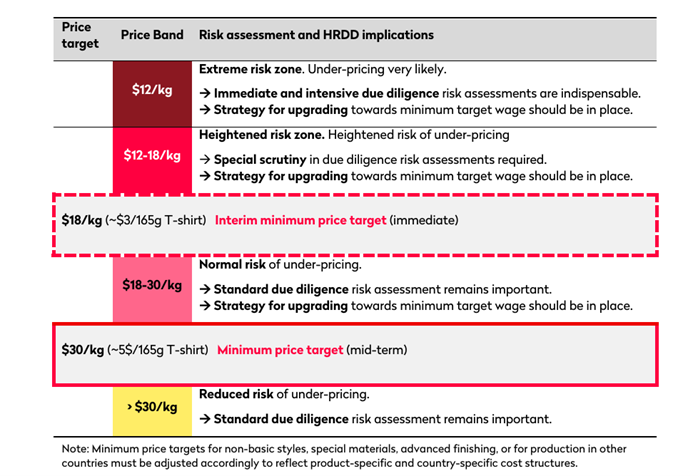
Figure 3: Minimum price targets as a human rights due diligence instrument. Source: Public Eye / Clean Clothes Campaign, 'Squeezed Dry: Pricing pressure in the global fashion industry', May 2026 (Box 4 in original report).
Workers and their trade unions must play a central role in the development and implementation of minimum price targets. Establishing the wage component through consultation and negotiation with trade unions ensures that benchmarks reflect legitimate, collectively agreed expectations rather than assumptions. Union involvement strengthens accountability by linking price targets to real improvements in wages and working conditions, supported by greater transparency on costing and prices. Sector‑wide coordination, including with unions, helps ensure that responsible pricing becomes an industry norm rather than a competitive disadvantage, grounded in respect for freedom of association and collective bargaining.
The report’s findings point to a clear conclusion: progress on wages, working conditions and environmental performance depends on addressing pricing directly. Tools like bottom‑up costing and minimum price targets do not offer a full solution, but they do show what responsible production actually costs, and where current practices fall short.
This creates space for a more honest and practical conversation across the fashion industry. Brands, suppliers, trade unions, and policymakers each have a role in shaping a sourcing model that is economically aligned with the commitments the sector has made, with worker representation essential to ensuring that pricing benchmarks are credible and grounded in real conditions.
From ETI’s tripartite perspective, this moment offers an opportunity to explore what a more stable and fair sourcing model could look like in practice. While the report provides one set of examples, the broader opportunity is for the industry to test approaches that support responsible production in real‑world conditions. ETI's work on responsible purchasing is increasingly integrated into our broader support for human rights due diligence. Where members are interested, ETI can help create space for these conversations and support the involvement of suppliers and trade unions in shaping practical and credible pathways forward.