Home

Main menu

  • About ETI
    • Our members
      • Public reporting performance
    • Who we are
      • ETI's origins
    • What we do
    • Global presence
    • Governance
    • Our team
      • ETI Board members
    • Our Strategy
  • Home
  • Why ETI
    • Why join ETI
  • ETI Base Code
    • Base Code overview
    • Base Code clause 1: Employment is freely chosen
    • Base Code clause 2: Freedom of association
    • Base Code clause 3: Working conditions are safe and hygienic
    • Base Code clause 4: Child labour shall not be used
    • Base Code clause 5: Living wages are paid
    • Base Code clause 6: Working hours are not excessive
    • Base Code clause 7: No discrimination is practiced
    • Base Code clause 8: Regular employment is provided
    • Base Code clause 9: No harsh or inhumane treatment is allowed
  • Our approach
    • Membership
    • Programmes
    • Transparency
    • Meaningful stakeholder engagement (MSE)
  • Our expertise
    • Climate change & Just transitions
    • Crisis response
    • Gender equity in supply chains
    • Worker representation
    • Forced labour & modern slavery
    • Responsible purchasing practices
      • RPP in manufacturing
    • Human rights due diligence
      • HRDD legislation tracker
  • Resources
    • Guidance & reports
    • Blog
      • Blog series: Tackling gender-based violence through GRACE
    • Issues
      • Human rights due diligence (HRDD): a complete guide for business
        • What is human rights due diligence?
        • Human rights due diligence legislation and regulatory requirements
        • How to implement human rights due diligence in your company
        • HRDD risk assessment for supply chains
        • Supplier engagement and human rights due diligence
      • Forced labour & modern slavery: a complete guide for business
        • What is modern slavery? Definitions, forms and scale
        • How to identify forced labour in your supply chain
        • Remediation: what to do when forced labour is found
        • Modern slavery legislation: what businesses need to know
        • EU Forced Labour Regulation: what it means for your business
        • How to write a modern slavery statement
        • High-risk sectors and sourcing regions for forced labour
        • Forced labour and migrant workers in supply chains
      • Responsible purchasing practices: what they are and why they matter
        • How to implement responsible purchasing practices
        • Responsible purchasing practices and legislation: what companies need to know
        • Responsible purchasing practices by sector
    • Case studies
    • Training
    • Events
      • ETI Insights series
    • Impact report 2024-25

Breadcrumb

  1. Home
  2. blog

Türkiye and Syria earthquake response 

  • Share on Facebook
  • Share on Twitter
  • Share on LinkedIn
  • ETI
  • 8 February 2023
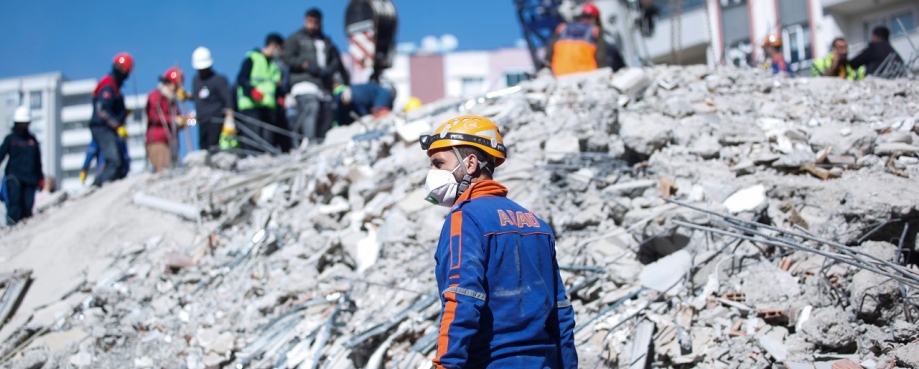
A man wearing a mask and helmet stands amid the rumble following an earthquake. Photo credit: murat photographer

On Monday 7 February, two earthquakes of 7.8 and 7.5 magnitude struck south-eastern Türkiye and north-western Syria. Over 300 aftershocks have been reported since, with devastating effects, toppling buildings, destroying roads and wrecking considerable destruction, injury and loss of life.

10 different Turkish cities (Adana, Adiyaman, Diyarbakir, Gaziantep, Hatay, Kahramanmaras, Kilis, Malatya, Osmaniye, and Sanliurfa) and five Syria governorates (Aleppo, Idlib, Lattakia, Hamma and extensive Damascus) have been impacted. Essential services, including electricity, gas, water, transportation and communication are severely damaged in each. At the time of writing, the death toll stands at 8,364, and this is expected to rise significantly as rescue efforts continue. 

“Our thoughts and sympathies are with all those affected, as both countries work to free survivors from the rubble and rebuild their lives.”

Peter McAllister, Executive Director, ETI 

This region hosts suppliers to all three sectors of ETI company membership; apparel and textile; food fishing and farming; and general merchandise. The regions affected are home to factories and mines supplying international brands and large groups of seasonal agricultural migrant workers who harvest a range of different commodities. Business has a part to play in recovery and support to affected workers and communities at this time. 

ETI will be engaging with company, trade union and NGO members to understand the impacts of this catastrophe on workers and supply chains. We will develop recommendations for effective business response which should include enhanced human rights due diligence and responsible business practices. We encourage all international buyers to play a role in recovery, ensuring they engage and support their affected suppliers, workers, and their representatives, during this state of emergency. 

ETI's blog covers issues at the intersection of business and human rights. We feature posts by, for and from our members and allies; we do not accept or offer payment for posts or publish content outside of these criteria. We welcome a range of insights and opinions from our guest bloggers, though don't necessarily agree with everything they say.

Stay up to date

Stay up to date with the latest from ETI via the following channels:
  • Email
  • Twitter
  • LinkedIn
  • Blog RSS

Get the latest

Subscribe to our email newsletters and stay up to speed on responsible business.

Subscribe

ETI elsewhere

  • Twitter
  • LinkedIn
  • YouTube

Footer

  • ETI Community
  • Accessibility
  • Contact
  • FAQ
  • Jobs at ETI
  • Press resources
  • Security & privacy
Other ETIs: Bangladesh, Denmark, Norway, Sweden
Ethical Trading Initiative | Registered No. 3578127