Get the latest
Subscribe to our email newsletters and stay up to speed on responsible business.

Collective action and gender just transitions in the agricultural sector
This research is part of a PhD partnership between Aishath Green, Northumbria University’s Centre for Global Development, ETI and Women Working Worldwide. It explores women’s collective action and gender just transitions in global food supply chains.
The importance of Just Transitions has gained increasing traction since its inclusion in the Paris Agreement in 2015. Defined by the ILO as “Greening the economy in a way that is as fair and inclusive as possible to everyone concerned, creating decent work opportunities and leaving no one behind”, its most recent development saw countries agree to establish a Just Transitions Mechanism at COP30 in Belém last year. This mechanism was widely called for across civil society and has been seen as a success in initiating a more unified roadmap that can enable countries “to share best practices” and “bring together governments, workers’ organisations, and communities under shared principles and commitments”. Yet despite this hopeful advancement there is still uncertainty around exactly how this mechanism will be actioned.
One area that has received attention in Just Transitions conversations across policy and civil society is the centrality of ensuring workers' perspectives are reflected in how Just Transitions unfold. This means effective representation and recognition of workers’ organisations, and it is often envisioned through the process of social dialogue, one of the IPCC’s core elements of a just transition. In theory, social dialogue advocates for collaboration between workers’ representatives, governments and employers on issues ranging from wages to working conditions. The ILO in particular sees it as “an invaluable tool for ensuring women’s participation and representation”. Yet with increasing calls for gender just transitions, women workers remain significantly underrepresented from the local level to higher policy scales. In this context, how can ongoing and future just transition strategies and implementation ensure that social dialogue works for women?
Across the globe, one quarter of employed women work in agriculture, making it a particularly important sector in terms of livelihood provision. Yet the agricultural industry is also increasingly impacted by the effects of climate change, as well as contributing over one third of greenhouse gas emissions. In this context, it is quickly becoming a more urgent area for gender just transition conversations, as women working in the industry face both threats to their livelihoods and food supply. As CGIAR comments, this is further compounded by structural constraints including “limited access to resources, unequal decision-making power and entrenched gender inequalities” which “constrain women’s effective participation and heighten their vulnerability to shocks and stressors like climate change”.
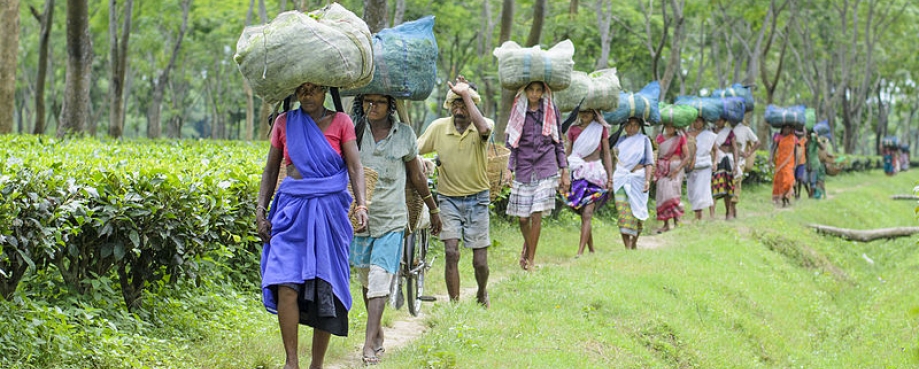
The tea sector illustrates these challenges with particular clarity. Women make up most of the tea work force in key producing countries such as India, as well as occupying the most labour-intensive positions. In this context they are directly impacted by climate challenges including rising temperatures, drought and floods which affect the optimal conditions needed to grow tea. Given many women are paid according to the weight of the leaves they pluck, this decline in yields can have significant repercussions for women’s wages.
Yet despite their centrality to the industry, women tea workers face limited upward mobility and are significantly underrepresented in managerial positions and trade unions which tend to be male-dominated. Research on female tea estate workers in Assam, for example, found that women “are generally excluded from trade union activities” due to longer working hours, caring responsibilities including housework and childcare, and fear of reprisal which can mean women play a “passive role in unionism”. As organisations that have played an important role in representing workers’ concerns, from ensuring equal pay for women in India and Malawi to enabling the rejection of unwanted tasks in Assam, this lack of participation poses significant challenges for inclusive social dialogue and effective gender just transitions.
In this context, scholars and practitioners have pointed towards the different ways in which women collectively come together to organise around daily concerns – issues including “health care, education, employment, pensions, occupational health and safety, and housing” which have been established as central to Just Transitions. In the tea sector this has included Self Help Groups, Mother’s Clubs, Savings Groups, or as reported by both the Ethical Trading Initiative and Women Working Worldwide “Safe Spaces” which enable women to come together and discuss their experiences. As their report on “Safe Spaces” finds, “almost all the examples of organising we studied originated away from the gaze of managers or factory or farm owners because of perceived or actual retaliation”. These modes of organising can be vital in the context of climate change and worsening conditions as they provide an important building block towards more formal mechanisms of negotiation. As CGIAR notes, they can “enhance women’s resilience by enabling peer support, resource sharing and knowledge exchange”. With employers keen for more guidance on how to support Just Transitions and workers, these methods of collective action can provide insight into the challenges women workers are facing, from care burdens to climate impacts.
To enhance worker representation through formal mechanisms such as social dialogue, it is important to consider how women’s different modes of organising can be incorporated into just transition discussions. This has already been recognised by organisations such as Global Alliance for Green and Gender Action which states in a recent policy brief “feminist movements and women-led community-based organisations are not only highlighting the multiple risks and challenges associated with just transition, but also championing the integration of knowledge and priorities from groups that are typically excluded from formal climate governance”. UN Women further underlines that the financing of these organisations will be fundamental for gender just Transitions. However, there is also a need to incorporate more everyday forms of organising which could provide vital insight into the kinds of climate challenges women are facing, yet which are struggling to make their way up the just transition dialogue chain. As many scholars have noted “collective action does not necessarily begin around a clear political vision” but rather “around more urgent, routine, and practical concerns”. It is in these arenas that women may “become more enthusiastic about engaging in public disputes”. As ETI and WWW remark, “there is often a realisation that effective improvements in working conditions will inevitably require workplace-based forms of organisation and unions”. It is vital then that further research and understanding is developed on how women can actively participate in organisations like unions.
As calls for worker representation in the form of social dialogue are enhanced in the context of global initiatives such as the Just Transition Mechanism, it is important to acknowledge the different ways in which women come together at the grassroots level, as well as addressing the structural constraints which see them continuously excluded from more formal mechanisms of representation that are often prioritised, or more easily recognised, at global levels. This does not mean abandoning more formal structures – trade unions and social dialogue can be important vehicles for supporting working women in the face of climate challenges and there are encouraging signs that this is already taking place. However, as women continue to face obstacles with representation, forms of organising that relate women’s everyday concerns can act as an important complement for enabling successful gender just transitions. The next step is understanding what just transitions mean to working women in their different contexts and ensuring that the diverse ways in which women are already organising around these questions are both recognised and resourced.
This blog was originally published by Northumbria University, Newcastle