Home

Main menu

  • About ETI
    • Our members
      • Public reporting performance
    • Who we are
      • ETI's origins
    • What we do
    • Global presence
    • Governance
    • Our team
      • ETI Board members
    • Our Strategy
  • Home
  • Why ETI
    • Why join ETI
  • ETI Base Code
    • Base Code overview
    • Base Code clause 1: Employment is freely chosen
    • Base Code clause 2: Freedom of association
    • Base Code clause 3: Working conditions are safe and hygienic
    • Base Code clause 4: Child labour shall not be used
    • Base Code clause 5: Living wages are paid
    • Base Code clause 6: Working hours are not excessive
    • Base Code clause 7: No discrimination is practiced
    • Base Code clause 8: Regular employment is provided
    • Base Code clause 9: No harsh or inhumane treatment is allowed
  • Our approach
    • Membership
    • Programmes
    • Transparency
    • Meaningful stakeholder engagement (MSE)
  • Our expertise
    • Climate change & Just transitions
    • Crisis response
    • Gender equity in supply chains
    • Worker representation
    • Forced labour & modern slavery
    • Responsible purchasing practices
      • RPP in manufacturing
    • Human rights due diligence
      • HRDD legislation tracker
  • Resources
    • Guidance & reports
    • Blog
      • Blog series: Tackling gender-based violence through GRACE
    • Issues
      • Human rights due diligence (HRDD): a complete guide for business
        • What is human rights due diligence?
        • Human rights due diligence legislation and regulatory requirements
        • How to implement human rights due diligence in your company
        • HRDD risk assessment for supply chains
        • Supplier engagement and human rights due diligence
      • Forced labour & modern slavery: a complete guide for business
        • What is modern slavery? Definitions, forms and scale
        • How to identify forced labour in your supply chain
        • Remediation: what to do when forced labour is found
        • Modern slavery legislation: what businesses need to know
        • EU Forced Labour Regulation: what it means for your business
        • How to write a modern slavery statement
        • High-risk sectors and sourcing regions for forced labour
        • Forced labour and migrant workers in supply chains
      • Responsible purchasing practices: what they are and why they matter
        • How to implement responsible purchasing practices
        • Responsible purchasing practices and legislation: what companies need to know
        • Responsible purchasing practices by sector
    • Case studies
    • Training
    • Events
      • ETI Insights series
    • Impact report 2024-25

Breadcrumb

  1. Home
  2. blog

Crisis time for banana pricing?

  • Share on Facebook
  • Share on Twitter
  • Share on LinkedIn
  • Alistair Smith - Banana Link
  • 31 October 2013
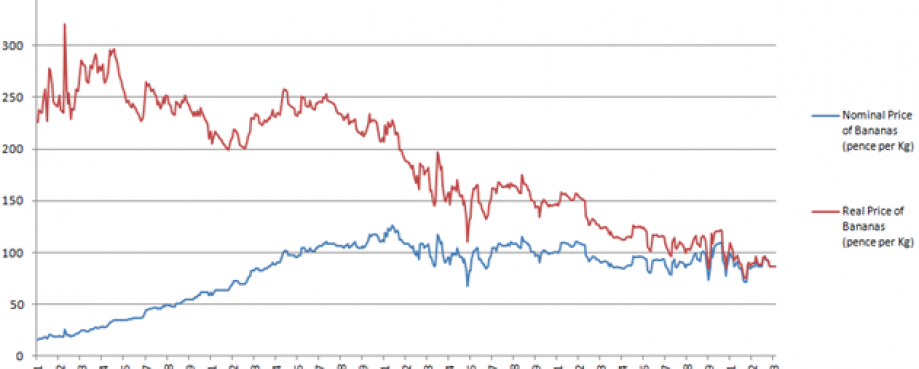
Graph of UK banana retail price

British retail buyers are acutely aware that the price wars (and 'promises') on their biggest food line cannot continue much longer. They are aware that selling loose bananas at 68p per kilo is destroying banana value for producers and workers worldwide. They are also aware that producers' costs continue to rise faster than the gradual reduction in banana import tariffs into the EU. They are aware that decent work in these chains is a goal that is put on hold as long as bananas are bought and sold too cheaply.

But so far none of them has managed to convince the commercial leadership of their companies to break out of the poverty-perpetuating logic of 'everyday low prices' on our favourite slow energy-releasing fast food. Who will break ranks and join the Co-op at more sustainable pricing levels? And, as 2014 contracts are being discussed, will we have to wait another year before the destructive downward pressure on producers and workers is eased?

Supplying the UK in current conditions, say producers large and small, is a mug's game!

In case anybody was in any doubt that the pricing practices of UK retail are not confined to Britannia's shores and are affecting other markets, let's take a look across the North Sea. Jumbo is the Netherlands' second biggest chain, a Dutch Asda equivalent, let's say. In October 2013, Jumbo proudly announced it was moving away from the traditional continental approach to banana promotion – 1 to 3 week cut prices, then back to normal – and is now selling its multinational branded fruit at 99 Euro cents (85p) per kilo. Until further notice. Meanwhile suggesting to consumers (and competitors) that sustainability is not being sacrificed. Just an 'investment in promotion', as the jargon goes. Jumbo is the first in continental Europe to take this 'so British' approach.

Even the German 'hard discounters' continue to believe in making a bit of a margin on loose banana sales. Average banana retail prices in Germany were around 97p per kilo last week. In France, they remain nearer £1.25 on average and are a cool £1.70 per kilo in France's largest global retailer, Carrefour – all for the same bananas sold in UK supermarkets.

Should civil society organisations be contributing to a debate characterised by a 'radio silence' approach from British retailers? From an ethical trading perspective, and as a member of ETI, Banana Link defends our right to have something to say. We have said – and will continue to say until a retailer breaks ranks on pricing – that selling below the cost of purchase should be illegal, Fairtrade certified or not.

We owe it to the millions of people in 15 countries of Latin America, the Caribbean and Africa to demonstrate clearly that plantation and packhouse workers and small-scale family farmers cannot survive on poverty prices that result from an 'everyday low price', value-stripped philosophy. Not even the big brands that own big plantations with all the economies of scale can cover costs in the UK market.

Three of the big four retailers now buy direct through their in-house produce sourcing companies. Direct sourcing currently accounts for 40% of the UK banana market. Close to 30% is Fairtrade labelled. But there is no overlap between these two shares. 

How much longer do the several hundred thousand people whose livelihoods depend on selling bananas to Britain have to wait before good business practice and ethical coherence break out? And do UK consumers, hard-pressed though they are, all agree that cheaper bananas at any cost is a good thing?

ETI's blog covers issues at the intersection of business and human rights. We feature posts by, for and from our members and allies; we do not accept or offer payment for posts or publish content outside of these criteria. We welcome a range of insights and opinions from our guest bloggers, though don't necessarily agree with everything they say.

Stay up to date

Stay up to date with the latest from ETI via the following channels:
  • Email
  • Twitter
  • LinkedIn
  • Blog RSS

Related content

  • Living wage resources
  • Living wage – the price of a decent cuppa?
  • The Sports Direct ‘how not to follow the ETI Base Code’ manual
  • From the horse's mouth
  • ACT - initiative on living wages
  • Living wage initiatives

Get the latest

Subscribe to our email newsletters and stay up to speed on responsible business.

Subscribe

ETI elsewhere

  • Twitter
  • LinkedIn
  • YouTube

Footer

  • ETI Community
  • Accessibility
  • Contact
  • FAQ
  • Jobs at ETI
  • Press resources
  • Security & privacy
Other ETIs: Bangladesh, Denmark, Norway, Sweden
Ethical Trading Initiative | Registered No. 3578127