Home

Main menu

  • About ETI
    • Our members
      • Public reporting performance
    • Who we are
      • ETI's origins
    • What we do
    • Global presence
    • Governance
    • Our team
      • ETI Board members
    • Our Strategy
  • Home
  • Why ETI
    • Why join ETI
  • ETI Base Code
    • Base Code overview
    • Base Code clause 1: Employment is freely chosen
    • Base Code clause 2: Freedom of association
    • Base Code clause 3: Working conditions are safe and hygienic
    • Base Code clause 4: Child labour shall not be used
    • Base Code clause 5: Living wages are paid
    • Base Code clause 6: Working hours are not excessive
    • Base Code clause 7: No discrimination is practiced
    • Base Code clause 8: Regular employment is provided
    • Base Code clause 9: No harsh or inhumane treatment is allowed
  • Our approach
    • Membership
    • Programmes
    • Transparency
    • Meaningful stakeholder engagement (MSE)
  • Our expertise
    • Climate change & Just transitions
    • Crisis response
    • Gender equity in supply chains
    • Worker representation
    • Forced labour & modern slavery
    • Responsible purchasing practices
      • RPP in manufacturing
    • Human rights due diligence
      • HRDD legislation tracker
  • Resources
    • Guidance & reports
    • Blog
      • Blog series: Tackling gender-based violence through GRACE
    • Issues
      • Human rights due diligence (HRDD): a complete guide for business
        • What is human rights due diligence?
        • Human rights due diligence legislation and regulatory requirements
        • How to implement human rights due diligence in your company
        • HRDD risk assessment for supply chains
        • Supplier engagement and human rights due diligence
      • Forced labour & modern slavery: a complete guide for business
        • What is modern slavery? Definitions, forms and scale
        • How to identify forced labour in your supply chain
        • Remediation: what to do when forced labour is found
        • Modern slavery legislation: what businesses need to know
        • EU Forced Labour Regulation: what it means for your business
        • How to write a modern slavery statement
        • High-risk sectors and sourcing regions for forced labour
        • Forced labour and migrant workers in supply chains
      • Responsible purchasing practices: what they are and why they matter
        • How to implement responsible purchasing practices
        • Responsible purchasing practices and legislation: what companies need to know
        • Responsible purchasing practices by sector
    • Case studies
    • Training
    • Events
      • ETI Insights series
    • Impact report 2024-25

Breadcrumb

  1. Home
  2. blog

A new direction for horticulture in Latin America

  • Share on Facebook
  • Share on Twitter
  • Share on LinkedIn
  • Nick Kightley - ETI
  • 19 June 2019
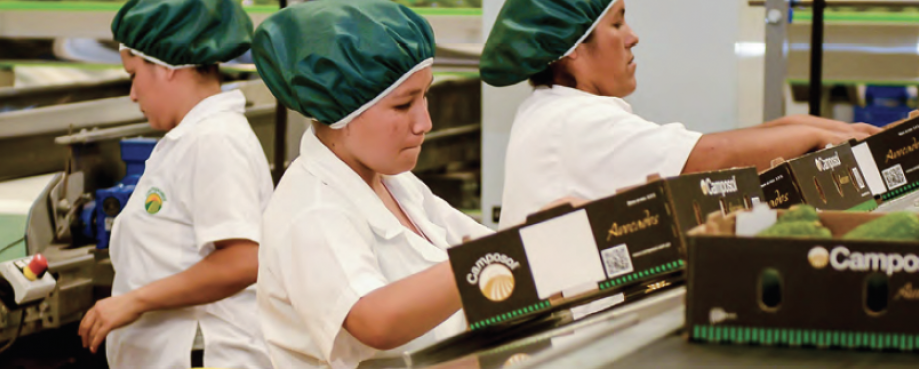
Female workers packing fresh produce, Peru

The turmoil taking place in Central and South America recently – workers and their families displaced, under threat, desperate for a new and better start in life - has been receiving deserved attention in the media.

While most of the issues are not new, our ETI member companies share many of the same humanitarian concerns anyone would have hearing such grim reports of cyclical poverty. These circumstances also create concerns about the stability and sustainability of supply, which is critical to business models and meeting consumers’ expectations.  When workers and communities are trapped in persistent hardship and there appears to be no hope of improvement, can we really expect a well-motivated and efficient workforce to meet ever-growing global demands? 

With this challenge in mind, ETI and a group of our members, has published a new study on labour practices in three Latin American countries to capture some of the employment policies and practices that offer models for improvement in the industry and define what ‘good’ looks like today. The study shines a light on progressive attitudes and behaviours among some companies and their worker representatives, including trade unions, and examines in detail the experiences of management and workers at a Peruvian company, Camposol, in particular.  

Unsurprisingly, the study found that challenging, often long-running, labour disputes are common; however, in some companies there has been a cultural shift towards the recognition that conflict does not need to be the norm for labour relations. Indeed, in the case of Camposol, management recognised the need to establish a new kind of relationship with workers and the trade unions that represent them, one based on “social dialogue” and mutual respect. This, in turn, has led to greatly improved worker-management relationships, creating pathways by which the many challenges faced by business and the thousands of individual employees can be acknowledged and collaborative solutions found. 

So what next? We aim for this study to provide a platform for further dialogue and for improved labour relations among companies in Latin America. We are exploring with a number of interested parties how best to share this learning and to bring about further improvements to employment relationships across wider industry sectors. Those interested to discuss the contents of this study and how they might contribute to further progress in Latin American labour relations, please do contact ETI. 

File(s)

Good practices in horticulture, Colombia, Mexico, Peru

A study of good practices in fresh produce imported by UK supermarkets from Colombia, Mexico and Peru.
Read more
ETI's blog covers issues at the intersection of business and human rights. We feature posts by, for and from our members and allies; we do not accept or offer payment for posts or publish content outside of these criteria. We welcome a range of insights and opinions from our guest bloggers, though don't necessarily agree with everything they say.

Stay up to date

Stay up to date with the latest from ETI via the following channels:
  • Email
  • Twitter
  • LinkedIn
  • Blog RSS

Related content

  • Our response to the GMB Union's call for multinational fruit company Fyffes to be expelled from ETI
  • Migrant worker exploitation in UK agriculture: ETI statement
  • Social dialogue, Peru horticulture
  • Good practices in horticulture, Colombia, Mexico, Peru
  • ETI and Partner Africa help African agricultural suppliers mitigate risk of Covid-19 
  • Miriam's story

Get the latest

Subscribe to our email newsletters and stay up to speed on responsible business.

Subscribe

ETI elsewhere

  • Twitter
  • LinkedIn
  • YouTube

Footer

  • ETI Community
  • Accessibility
  • Contact
  • FAQ
  • Jobs at ETI
  • Press resources
  • Security & privacy
Other ETIs: Bangladesh, Denmark, Norway, Sweden
Ethical Trading Initiative | Registered No. 3578127