Get the latest
Subscribe to our email newsletters and stay up to speed on responsible business.

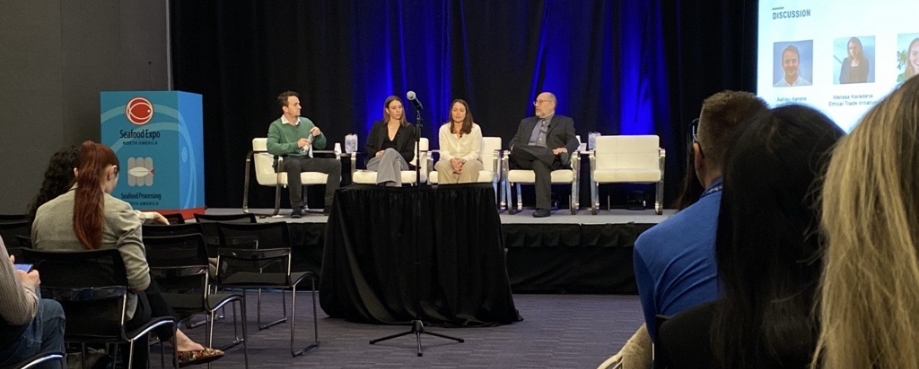
This year’s Seafood Expo North America (SENA) made one thing clear: responsible purchasing practices (RPP) are finally entering the seafood sector’s mainstream conversation — but they are still far from where they need to be.
I had the pleasure of joining a panel organised by Oxfam USA on responsible purchasing practices. Despite the importance of the topic, it remains under‑discussed in industry spaces, and the session highlighted just how essential it is to bring purchasing practices and human rights conversations together.
Seafood buyers are increasingly making commitments to respect human rights in their operations and supply chains. Yet recent reports — including ETI’s own research — show how certain purchasing practices can directly contribute to abuse: pushing prices below the cost of production, unpredictable or one‑sided contracts, short lead times, and over‑reliance on spot markets.
As Ashley from Oxfam America put it during the session: “We’re seeing more companies talk about human rights, but far fewer are looking at how their own purchasing decisions may be driving the very risks they’re trying to solve.”
The Oxfam session focused on how businesses can enhance their purchasing practices so that how they buy aligns with their human rights commitments.
Our recent study on shrimp supply chains showed a clear pattern: human rights risks are systemic — appearing across countries, across tiers, and across production systems. Workers face low wages, long hours, unsafe conditions, insecure work, and in some cases forced labour.
Yet most companies still rely on governance tools — audits, codes of conduct, certifications — that often fail to capture the full range of risks. What’s been missing is attention to the downstream commercial decisions that shape what suppliers can realistically deliver.
One of the clearest indicators of commercial pressure highlighted by the research is pricing.
Between 2016 and 2025, the average retail price of warm‑water shrimp in the UK increased by nearly 19%. Consumers are paying more. But import prices tell a different story:
This trend is global. Producers are receiving less than they did a decade ago.
Falling prices create pressure throughout the supply chain. They affect wages, working conditions, and suppliers’ ability to invest in safer or more sustainable practices. Unless we look at these commercial pressures, human rights risks will persist — no matter how many audits or certifications are in place.
Oxfam’s research makes the stakes clear. Any human rights abuse within supply chains exposes buyers and suppliers to legal, financial, operational, and reputational risks. Procurement teams play a central role in preventing these risks — but only if they understand how their decisions affect suppliers and workers.
Ashley made an important point: without examining purchasing practices, companies risk undermining their own human rights commitments, no matter how strong their policies or audits may be.
Oxfam identified several challenges in current seafood procurement, including lowest‑cost sourcing, short‑term contracting, limited traceability, weak gender considerations, and few commitments to living wages. But they also highlighted emerging good practices: embedding human rights KPIs into procurement teams, valuing long‑term sourcing relationships, adopting sustainable costing models, and supporting suppliers to implement improvements.
Richard Stavis, another panellist, offered a candid view from the importer side on why these challenges persist. He emphasised the importance of understanding the commercial context in which the sector operates: “It is important to understand where industry is coming from. Historically this has been a low margin business, and importers and wholesalers have had to tightly control costs in order to survive in a competitive environment. Customers historically and (for the most part, currently) have asked for the cheapest price. The tools that importers can use to ensure human rights best practices have improved, but the culture has to change as well. Customers need to share the risk of higher product in competitive environments, through both fixed price contracts and informed spot purchases. Additionally, company incentives must be reworked to include rewards for progress in this area as well as reduce the focus on sheer profitability at the expense of other priorities.”
His comments reenforced a central point: the sector’s pricing culture is not a fixed reality, but the result of choices made along the supply chain. Unless buyers adjust how they source and what they reward, suppliers could continue to face pressures that undermine human rights commitments.
Sarah from WWF offered a practical example of what responsible procurement looks like inside a company. Their approach includes robust sourcing policies, embedding human rights personnel within procurement processes, and ensuring those who make purchasing decisions are informed on why these issues matter. As she explained:
“Responsible procurement isn’t an add‑on — it is how we do business. With clear sourcing policies and a commitment from the top down to uphold these, it is simply normal practice.”
Her team uses onboarding as a lever for change — supporting suppliers to meet standards and embed continuous improvement. Long‑term contracts of three to five years provide the stability needed for both World Wise Foods and their suppliers to invest in change and allow that improvement to take root. Sarah captured this well:
“Long‑term, fair partnerships aren’t just good for workers — they are good for business. They create the confidence the supply base may need to invest and improve.”
This is not an outlier — it is what responsible procurement looks like when it becomes standard practice; the question is how many more companies are willing to make that shift.
Richard Stavis, another panellist, echoed this from the perspective of an importer. He reminded the room that responsible procurement cannot scale unless the commercial culture shifts too. Seafood has long been a low‑margin sector where customers have demanded the cheapest price, pushing importers to tightly control costs. As he explained:
“Customers need to share the risk of higher product in competitive environments, through both fixed price contracts and informed spot purchases. And company incentives must be reworked to reward progress in this area, not just sheer profitability.”
Across SENA, many sessions focused on traceability, farm‑level improvements, and producer‑country responsibilities. These are important conversations — but there was noticeably less discussion about the role of retailers and food companies in enabling those improvements — and that gap matters.
In conversations with supply chain stakeholders, NGOs, and the international community, several themes came up repeatedly:
Producers told me openly that they are being asked to meet more social and environmental requirements each year, but without a premium or a commitment to long‑term collaboration. This makes it particularly hard for smaller producers to keep up.
Despite the challenges, there are real opportunities for the shrimp sector to shift purchasing practices in a meaningful way. ETI has launched a two-year project for retailers and food companies to examine how their commercial decisions are shaping conditions in shrimp supply chains — and to improve them, collectively and practically. If you are a retailer or food company and want to understand what this means for your business, we want to hear from you.
If the seafood industry wants to move toward transparency, resilience — especially in the face of the climate crisis — and strong environmental and social standards, purchasing practices must be part of the conversation. We cannot expect processors and farmers to shoulder the entire burden of sustainability while commercial practices make it harder for them to operate responsibly.