Get the latest
Subscribe to our email newsletters and stay up to speed on responsible business.

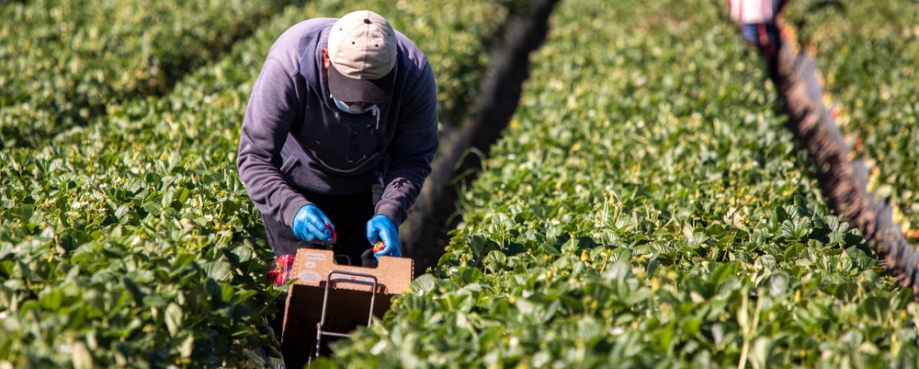
Agrifood systems sit at the heart of our global economy and society. Over 1 billion people — around one third of the global labour force — are directly employed in the sector and nearly 4 billion people live in households at least partly reliant on it. The sector is central to progress on food security, rural livelihoods, environmental sustainability, and the Sustainable Development Goals.
Yet workers in the agrifood sector face precarious employment and livelihood realities, including persistent, endemic and structural violation of rights. The sector is often characterised by serious decent work deficits. ETI member the IUF, the global union federation representing workers across food and agriculture, emphasises the “pervasive and ongoing exclusion of agricultural workers from exercising their fundamental right to freedom of association and collective bargaining”.
The agrifood sector is one of the most hazardous sectors of activity in the world. 13% of all adult forced labour exploitation globally occurs in agriculture. The sector accounts for the majority of child labour worldwide, with 60% of all child labourers aged between 5-17 years working in the agrifood sector, amounting to over 98 million girls and boys. An ILO report highlights that “sexual violence and harassment among commercial agricultural workers is widespread, perhaps even pervasive, throughout the world”. The ILO Bureau for Workers’ Activities (ACTRAV) indicates that about 80% of the world’s poor reside in rural areas.
Closing those notable and widespread decent work deficits requires high-level commitment and collaboration across numerous stakeholders, including governments, employers and workers’ organisations. It requires agreement and articulation of international standards and an accountability mechanism by which to ensure implementation of those standards. As ETI set out in February 2026, the International Labour Organisation (ILO) provides normative legitimacy and practical guidance for the world of work, including when it comes to rural employment and the agrifood sector. A position that has been firmly established for over a century, highlighted in 1922 by the Permanent Court of International Justice’s ruling that the ILO categorically had the competence to include agricultural labour in its mandate.
The ILO’s work with its tripartite constituents (governments, employers’ and workers’ organisations) promotes safer, more equitable and decent working conditions in the sector. Key instruments developed by the ILO specifically for the agrifood sector, including the Safety and Health in Agriculture Convention (C184) and the Labour Inspection (Agriculture) Convention (C129) have been instrumental in improving and enforcing conditions for workers in the sector. The ILO Policy Guidelines for the promotion of decent work in the agri-food sector, negotiated by ILO tripartite members in May 2023, provide an important framework, grounded in social dialogue and operationalising relevant international labour standards, with a specific focus on their relevance and application in the agri-food sector. The International Organisation of Employers acknowledges the guidelines’ emphasis that the agri-food sector “can be an important driver of decent work and sustainable enterprise development”.
In the context of financial headwinds and a changing multilateral environment the ILO is progressing with a reform process. At the next ILO Governing Board meetings, being held from 23 March to 2 April 2026, there will be discussions on proposals for concrete reprioritisation of the ILO’s efforts. The outcomes of these discussions will shape the future of global food systems and directly affect the conditions for over a billion workers in the sector.
We urge the ILO to continue its critical work on promoting decent work, social dialogue, labour protection and social protection for rural workers, including in the agrifood sector, so that they can access their human rights. This concern is shared across the labour movement — the IUF has written directly to ILO Director-General Gilbert Houngbo warning that any deprioritisation of rural employment would weaken the ILO's ability to translate labour standards into practice. Promotion of decent work in the sector through the operationalisation of ILO instruments also matters directly to businesses, supporting resilient supply chains, improved productivity, and competitive enterprises.
We are encouraged to see the ILO’s commitment to “promoting decent work for agricultural workers through initiatives that enhance the implementation of international labour standards, access to labour rights, and improved working conditions, and reinforce sectoral social dialogue”. We acknowledge the proposed integration of rural employment and livelihoods more systematically into the ILO’s work on the transition from the informal to the formal economy. However, whilst this integration attempts to recognise the realities faced by many workers in rural areas, it risks overlooking that much of the agrifood sector is formalised, including in rural areas.
Diluting the sector focus, through a distinction between waged agricultural workers and rural employment and livelihoods, may serve to create siloed approaches that don’t adequately consider the nuances of the sector and the specific considerations and root causes that are driving decent work deficits in those areas. Encouragingly, at the Sixth Global Conference on Child Labour in February 2026, ILO leadership reaffirmed its commitment to advancing social justice and strengthening protections for agricultural workers; a welcome signal ahead of the Governing Body meetings.
As the only UN agency with a tripartite structure, the ILO is uniquely mandated to establish and promote international labour standards that protect workers across all sectors. This leadership is urgently needed in the agrifood sector, where decent work deficits remain severe and systemic. We encourage the ILO to maintain a strong and explicit focus on rural and agrifood workers through its reform process, ensuring that its normative frameworks and implementation efforts continue to reach the people who need it most.
ETI and our members stand ready to support this ambition as committed partners in advancing decent work worldwide.