Get the latest
Subscribe to our email newsletters and stay up to speed on responsible business.

Stirling Smith, ETI trainer and blogger, was in Dhaka recently and read a newspaper report that revealed an ugly truth.
After the President's Club and Harvey Weinstein exposés, it seems that sexual harassment is getting more attention - at least in the USA and UK.
Women workers in the garment industry in south Asia sadly, are unlikely to benefit. Not because they lack smart phones and so can’t use the hashtag.
No, the reason is that western buyers are not using their leverage to force suppliers to do anything.
While all the evidence shows that sexual harassment is a huge problem faced by women in garment factories in Bangladesh and India, it somehow does not appear in corrective action plans in audits.
Audit non-compliances are coded against code clauses (we are talking about the ETI Base Code here) and typically 50% are coded as safety and health issues and around 1% are coded in the harassment category.
Now this is very odd. Because when we look at research based on interviews with women workers, by academics and NGOs, the statistics tell us a very different story.
This is the incidence of sexual harassment, in selected countries:
This data is obtained by asking women off site, in their communities.
Even then, it is often reported as “this happened to a friend of mine” because of the shame that the women feel.
So, what is going on?
As I pointed out in a previous blog, 80 per cent of women in the UK who suffer from sexual harassment do not report it. So how can we expect women in highly patriarchal societies like India and Bangladesh to open out to a social auditor?
The fact is, misogyny seems to be endemic. I was just in Dhaka and read a news report about a recent survey which found that a whopping 94 percent of women experienced sexual harassment when using public transport in Dhaka.
A lot of these are women travelling to work in garment factories. More than one in four started to wear the hijab in a desperate attempt to fend off the leering, groping and worse.
Mysteriously, the rate of sexual harassment declines to a statistically insignificant level when these women walk inside the factories. Doesn't make sense does it?
That's too complicated for the normal social auditor. All these reports are from outside the factory, so are not valid evidence.
Time to do something they understand, like check the right kind of gauze is in the First Aid box. And anyway, the factory has a zero tolerance of sexual harassment. It says so, in a document specially prepared for foreign buyers.
There is a clause in the Bangladesh Labour Act about sexual harassment. But it’s not very useful.
332. Conduct towards women…Where any woman is employed in any work of any establishment, whatever her rank or status may be, no person of that establishment shall behave with her which may seem to be indecent or unmannerly or which is repugnant to the modesty or honour of that woman.
If a woman worker wants to make a complaint, her only course of action is to approach the Labour Court.
Yet, in September 2016, in the Labour Courts of Bangladesh, 15,128 cases were pending, and 11,272 cases were pending for more than six months. In effect, the imbalance of power makes the Conduct towards women LabourAct clause nonjusticiable and there have been no cases filed under it.
However, there is a better piece of law available.
In a judgement in 2009, The Dhaka High Court made it mandatory for workplaces (and educational establishments) to set up sexual harassment complaint committees.
Essentially, the judgment copied many of the provisions in the Indian Supreme Court's landmark Visakha guidelines of 1997. These were finally turned into a statute law in India in 2013. I blogged about it then.
But l have not heard of any garment factories in Bangladesh setting up these committees – and believe me, I keep asking. The line followed is, it's a court judgment, we must wait for the government to legislate.
Well, that’s nonsense. Bangladesh follows the principles of English law. A court order is a court order and is law unless replaced by statute.
The labour law is being "revised" by the Bangladesh government right now – watch out for another blog by me about that soon. Suffice to say, the government seems to have ruled out incorporating the provisions of the High Court judgement into the law.
Let's cross the Radcliffe Line over into India and see if the situation is any better.
The crime of sexual harassment is just as prevalent.
One in seven women garment workers in Bengaluru (Bangalore as was) reported having been raped or forced to commit a sexual act. Gurgaon, near Delhi, is another reported hotspot.
And the corporate response? The leading employers’ organisation, FICCI, surveyed member companies. And found 30% were not compliant with the law.
Now, that is not so bad. But, bear in mind that FICCI members are the creme de la creme of corporate India. They are blue chip companies with global brand exposure, and a highly educated workforce.
Not garment factories. So, we can assume that the compliance rate is much worse.
But, compared to Bangladesh, the situation in India is better.
Much more publicity has pushed some local administrations to demand action by companies. The evidence we have though, is that compliance in garment factories is poor.
UK companies sourcing from South Asia really need to get the message, and:
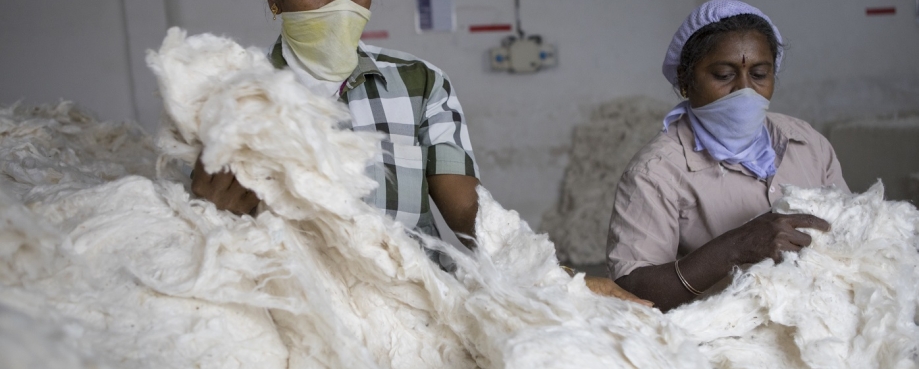
The photograph at the top of the page is a generic image of cotton mill workers in India and is for illustrative purposes only. It does not refer to an incidence of sexual harassment.