Home

Main menu

  • About ETI
    • Our members
      • Public reporting performance
    • Who we are
      • ETI's origins
    • What we do
    • Global presence
    • Governance
    • Our team
      • ETI Board members
    • Our Strategy
  • Home
  • Why ETI
    • Why join ETI
  • ETI Base Code
    • Base Code overview
    • Base Code clause 1: Employment is freely chosen
    • Base Code clause 2: Freedom of association
    • Base Code clause 3: Working conditions are safe and hygienic
    • Base Code clause 4: Child labour shall not be used
    • Base Code clause 5: Living wages are paid
    • Base Code clause 6: Working hours are not excessive
    • Base Code clause 7: No discrimination is practiced
    • Base Code clause 8: Regular employment is provided
    • Base Code clause 9: No harsh or inhumane treatment is allowed
  • Our approach
    • Membership
    • Programmes
    • Transparency
    • Meaningful stakeholder engagement (MSE)
  • Our expertise
    • Climate change & Just transitions
    • Crisis response
    • Gender equity in supply chains
    • Worker representation
    • Forced labour & modern slavery
    • Responsible purchasing practices
      • RPP in manufacturing
    • Human rights due diligence
      • HRDD legislation tracker
  • Resources
    • Guidance & reports
    • Blog
      • Blog series: Extreme heat and risks to workers
      • Blog series: Tackling gender-based violence through GRACE
    • Issues
      • Human rights due diligence (HRDD): a complete guide for business
        • What is human rights due diligence?
        • Human rights due diligence legislation and regulatory requirements
        • How to implement human rights due diligence in your company
        • HRDD risk assessment for supply chains
        • Supplier engagement and human rights due diligence
      • Forced labour & modern slavery: a complete guide for business
        • What is modern slavery? Definitions, forms and scale
        • How to identify forced labour in your supply chain
        • Remediation: what to do when forced labour is found
        • Modern slavery legislation: what businesses need to know
        • EU Forced Labour Regulation: what it means for your business
        • How to write a modern slavery statement
        • High-risk sectors and sourcing regions for forced labour
        • Forced labour and migrant workers in supply chains
      • Responsible purchasing practices: what they are and why they matter
        • How to implement responsible purchasing practices
        • Responsible purchasing practices and legislation: what companies need to know
        • Responsible purchasing practices by sector
    • Case studies
    • Training
    • Events
      • ETI Insights series
    • Impact report 2024-25

Breadcrumb

  1. Home
  2. blog

A chain is only as strong as its weakest link: Why EU mandatory due diligence legislation must include homeworkers

  • Share on Facebook
  • Share on Twitter
  • Share on LinkedIn
  • 18 February 2022

Join us for a side session at the OECD Forum on Due Diligence in the Garment and Footwear Sector next week.

Date and time: 25 February  2022 at 11:00 GMT | 12:00 CET| 16:30 IST | 06:00 EST

Languages: English with French and Spanish interpretation available.

About the side session

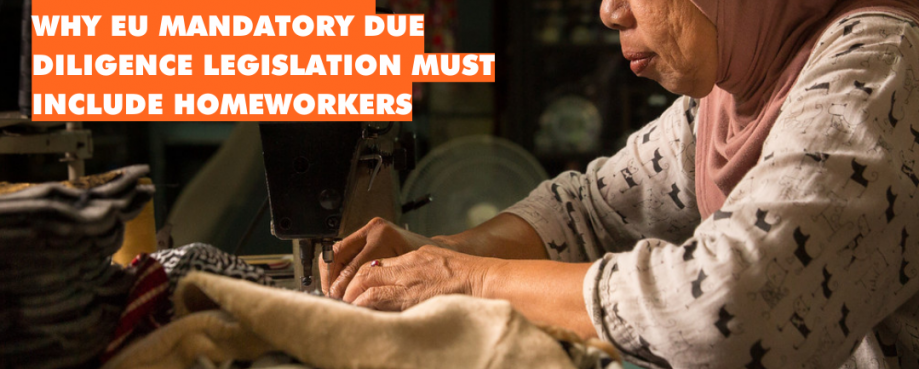
Subcontracting is ubiquitous in garment supply chains.  Almost 90% of workers in garment supply chains in India work in workshops and from their homes. These millions of invisible, mainly female supply chain workers, are excluded from labour law protections and their human rights are routinely violated.

The proposed EU legislation and mandatory corporate due diligence presents an opportunity for transformative change across the garment industry.

Join us for a 90-minute panel discussion that makes the case for homeworkers to be included in EU legislation and corporate due diligence. Panelists, including homeworkers and their representatives, organisers and researchers from across Asia and around the world, will present:

  • What does due diligence look like in homeworker supply chains: best practice by leading brands;
  • The demands that homeworker organisations are making of EU policy makers for inclusion in the proposed EU Mandatory Human Rights Due Diligence Directive; and
  • Explore the Hidden Homeworkers toolkit, to assist brands in improving transparency and working conditions within homeworker supply chains, to prevent human rights violations.
Panelists include:
  • Janhavi Dave: International Coordinator, HomeNet International (India)
  • Mary Viyakula: Executive Director, SAVE - Social Awareness and Voluntary Education (India)
  • Zehra Khan: General Secretary, Home-based Women Workers Federation (Pakistan)
  • Marlese von Broembsen: Law Programme Director, WIEGOLucy Brill: Director, Homeworkers Worldwide (United Kingdom)
Register here

HWW's participation in this event is an activity of the Hidden Homeworkers project, a consortium of NGOs supporting homeworkers and other women workers in precarious employment, producing for global brands in the apparel, footwear and homeware sectors. The project is led by Traidcraft Exchange working in partnership with HomeNet South Asia and Homeworkers Worldwide, and with local civil society partners in five cluster locations in India, Pakistan and Nepal, co-funded by the European Union.

ETI's blog covers issues at the intersection of business and human rights. We feature posts by, for and from our members and allies; we do not accept or offer payment for posts or publish content outside of these criteria. We welcome a range of insights and opinions from our guest bloggers, though don't necessarily agree with everything they say.

Stay up to date

Stay up to date with the latest from ETI via the following channels:
  • Email
  • Twitter
  • LinkedIn
  • Blog RSS

Get the latest

Subscribe to our email newsletters and stay up to speed on responsible business.
Subscribe

ETI elsewhere

  • Twitter
  • LinkedIn
  • YouTube

Footer

  • ETI Community
  • Accessibility
  • Contact
  • FAQ
  • Jobs at ETI
  • Press resources
  • Security & privacy
Other ETIs: Bangladesh, Denmark, Norway, Sweden
Ethical Trading Initiative | Registered No. 3578127