Get the latest
Subscribe to our email newsletters and stay up to speed on responsible business.

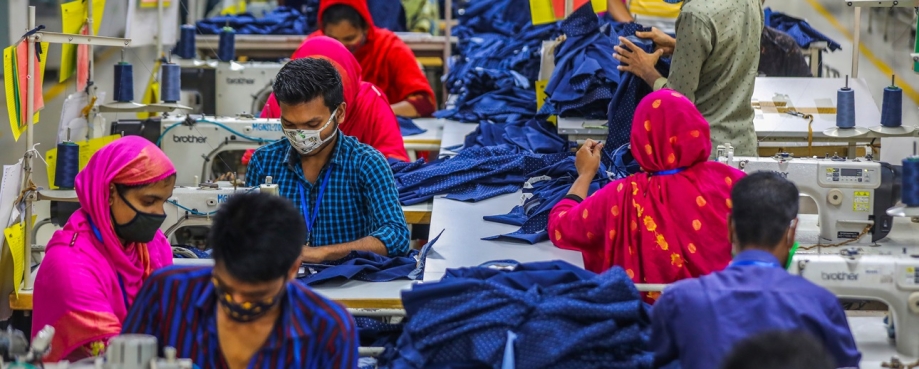
The Employment Injury Scheme (EIS Pilot) is a milestone for Bangladesh’s export-oriented ready-made garment (RMG) workers, with the potential to shield them from the financial storm of workplace injuries and death.
This ground-breaking initiative not only safeguards workers’ well-being but also paves the way for a safer and healthier work environment through comprehensive data gathering and learning on responding to occupational accidents, diseases, and rehabilitation.
When a working member of a family, especially a ‘breadwinner’, dies, it's like a ship losing its anchor. Entire families can be set adrift, unsure of how to survive, and with no amount of compensation able replace a loved one. But still the Employment Injury Scheme (EIS) Pilot initiative can provide a glimmer of hope in this darkness. It helps to secure a family's livelihood, ensuring that basic needs can still be met amid grief. The EIS Pilot can provide financial security, giving families the peace of mind to know that they will be able to weather the storm if the worst should happen.
The EIS Pilot and the Ethical Trading Initiative (ETI) share common visions centred around promoting workers' rights and ensuring decent working conditions in complex industries such as the RMG sector in Bangladesh. The EIS Pilot, with its focus on providing compensation for work-related injuries, offers a safety net for those facing adversity. It extends its support to the permanently disabled and the families of deceased workers, ensuring their basic needs are met through monthly payments and pensions, all in accordance with international labour standards (ILO Convention No. 121). Simultaneously, ETI collaborates with businesses, NGOs, and trade unions, striving to create workplaces where human rights are respected, and workers are treated with dignity.
The Deutsche Gesellschaft für Internationale Zusammenarbeit (GIZ), the German Technical Cooperation Agency, and the International Labour Organization (ILO) support the Bangladesh owned EIS Pilot initiative. GIZ and the ILO provide technical assistance to the Ministry of Labour and Employment (MoLE), the social partners and other stakeholders to implement the initiative effectively. ETI has played a crucial role in assisting GIZ and the ILO to facilitate the involvement of many more brands and retailers in the training sessions of the EIS Pilot.
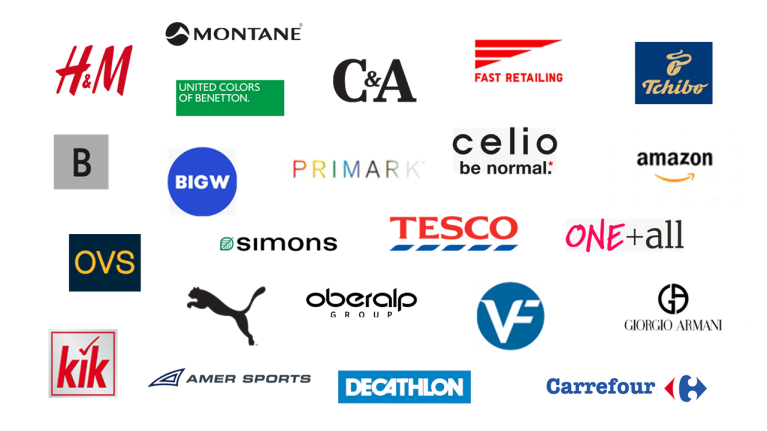
30 brands have already signed up to the Employment Injury Scheme. Including several ETI members.
More than 30 brands and retailers have already committed to support the EIS Pilot financially, with a yearly contribution of 0.019% of their respective RMG export volume from Bangladesh. For example, a committed brand with an RMG export volume per year from Bangladesh of 100 million USD, would provide yearly financial support to the EIS Pilot of 19,000 USD.
ETI company member, One+All is an early participant in the EIS scheme. Overseas Director, Ken Edgar, explains why they got involved.
“We’re extremely aware of our responsibilities to the workers who make our garments. In 2018, we became a Certified B Corporation and a full member of the Ethical Trading Initiative, reinforcing our longstanding commitment to ethical practices in our supply chain. We didn’t hesitate to get involved in the EIS scheme. Taking part is the right thing for us, giving greater reassurance to our workers, should they suffer an accident or worse. Our relationship with ETI is critical in steering us to make ongoing improvements for our workers, and we want to encourage more RMG sector brands to step forward and commit to the EIS scheme.”
On August 2022, Jabir and Jobaer's father died while working in a Bangladesh garment factory, crushed by a heavy weight of clothes. In an instant, their world was turned upside down. A man lost his life and family, a woman lost her husband, and two children lost their beloved father. Amidst the devastating loss, the EIS Pilot could provide support. Jabir and Jobaer’s case became the first claim handled by this initiative, leading to monthly compensation for the family and many others in similar situations. Through compensation rules agreed upon by a 13-member tripartite Governance Board, comprised of representatives from Government, workers, and employers’ organisations, Jabir, Jobaer, their mother, and their paternal grandfather are now receiving a monthly pension, consisting of a percentage of the last month’s salary of their deceased father.
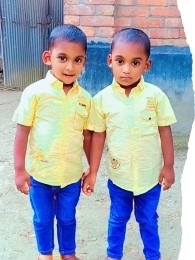
Jabir and Jobaer, two children supported by the EIS pilot.
Jabir and Jobaer's story is just one of many in which the EIS Pilot initiative has been able to make a difference in the lives of garment workers and their families. It is a story of resilience and hope in the face of adversity.
The EIS Pilot initiative is the first social insurance scheme initiative providing a financial benefit to garment workers and their families in case of work-related death and permanent disability. While it is a time bound approach to be transformed into a national system based on employers’ contribution, it is already a testament to the commitment of the Bangladeshi Government, the industry and its workers’ unions, to the well-being of their workers.
Join the EIS Pilot and team up with the other participating brands to enable the transformation. For more information visit - https://eis-pilot-bd.org