Home

Main menu

  • About ETI
    • Our members
      • Public reporting performance
    • Who we are
      • ETI's origins
    • What we do
    • Global presence
    • Governance
    • Our team
      • ETI Board members
    • Our Strategy
  • Home
  • Why ETI
    • Why join ETI
  • ETI Base Code
    • Base Code overview
    • Base Code clause 1: Employment is freely chosen
    • Base Code clause 2: Freedom of association
    • Base Code clause 3: Working conditions are safe and hygienic
    • Base Code clause 4: Child labour shall not be used
    • Base Code clause 5: Living wages are paid
    • Base Code clause 6: Working hours are not excessive
    • Base Code clause 7: No discrimination is practiced
    • Base Code clause 8: Regular employment is provided
    • Base Code clause 9: No harsh or inhumane treatment is allowed
  • Our approach
    • Membership
    • Programmes
    • Transparency
    • Meaningful stakeholder engagement (MSE)
  • Our expertise
    • Climate change & Just transitions
    • Crisis response
    • Gender equity in supply chains
    • Worker representation
    • Forced labour & modern slavery
    • Responsible purchasing practices
      • RPP in manufacturing
    • Human rights due diligence
      • HRDD legislation tracker
  • Resources
    • Guidance & reports
    • Blog
      • Blog series: Tackling gender-based violence through GRACE
    • Issues
      • Human rights due diligence (HRDD): a complete guide for business
        • What is human rights due diligence?
        • Human rights due diligence legislation and regulatory requirements
        • How to implement human rights due diligence in your company
        • HRDD risk assessment for supply chains
        • Supplier engagement and human rights due diligence
      • Forced labour & modern slavery: a complete guide for business
        • What is modern slavery? Definitions, forms and scale
        • How to identify forced labour in your supply chain
        • Remediation: what to do when forced labour is found
        • Modern slavery legislation: what businesses need to know
        • EU Forced Labour Regulation: what it means for your business
        • How to write a modern slavery statement
        • High-risk sectors and sourcing regions for forced labour
        • Forced labour and migrant workers in supply chains
      • Responsible purchasing practices: what they are and why they matter
        • How to implement responsible purchasing practices
        • Responsible purchasing practices and legislation: what companies need to know
        • Responsible purchasing practices by sector
    • Case studies
    • Training
    • Events
      • ETI Insights series
    • Impact report 2024-25

Breadcrumb

  1. Home
  2. blog

New commitments announced under the UK Seasonal Agricultural Workers Scheme

  • Share on Facebook
  • Share on Twitter
  • Share on LinkedIn
  • Cara Casey-Boyce - ETI
  • 10 May 2024
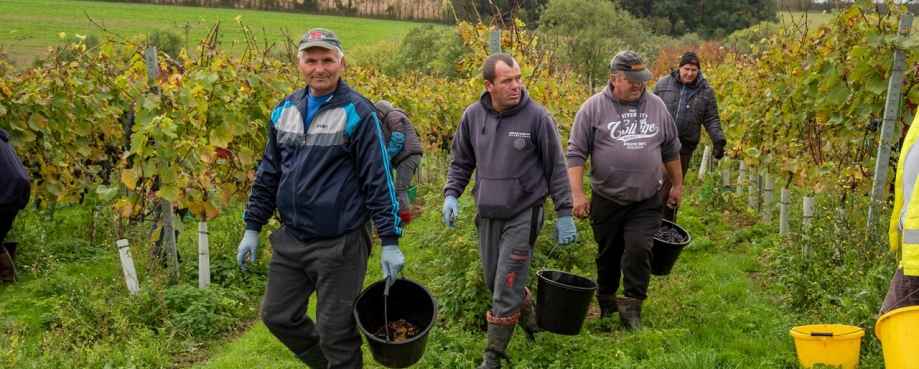
Romanian workers picking Pinot Noir grapes in a vineyard in Hampshire on a damp overcast and cloudy day in late October. Photo credit: Shutterstock.

This week the UK government responded to an Independent Review into labour shortages in the food supply chain, announcing several new commitments, among them is a five-year extension of the Seasonal Agriculture Workers Scheme (SAWS) and an investigation into the use of the ‘Employer Pays Principle’. 

The SAWS enables individuals to come to the UK and work in the horticulture and poultry production sectors. The scheme relies on those who choose to migrate to pay their own way to UK shores, resulting in too many cases where migrant workers arrive via the SAWS in significant debt, vulnerable to further exploitation and unable to access enough work during their stay to settle debts or earn a profit. 

Although this is not true for all who migrate via the SAWS, too many workers continue to face this fate. While an extension of the scheme is important to give growers and others some sense of continuation while other commitments are put in place, this alone is not enough. More needs to be done to ensure the costs migrant workers incur to bring food to UK and European markets, are shared along the value chain. 

ETI welcomes the government’s decision to open the door for much needed improvements, as stated in their response:

“The government remains open to making improvements to the visa route throughout its 5-year extension and will explore the feasibility of potential improvements in due course.”

“In committing to the extension of the Seasonal Worker visa route the government will remain unwavering in its commitment to reduce the risks of labour exploitation and modern slavery”

“This includes our commitment to investigating the use of the Employer Pays Principle for the Seasonal Worker visa route.” 

ETI Director Peter McAllister says “There is an urgent need for improvements in the scheme, that includes the reduction of risks of labour exploitation and modern slavery, and the Employer Pays Principle. Workers should not arrive in the UK already in debt and without a guarantee of being able to make a profit. ETI will continue to work with others to ensure these changes are put in place in way that is fair and sustainable.”

ETI's blog covers issues at the intersection of business and human rights. We feature posts by, for and from our members and allies; we do not accept or offer payment for posts or publish content outside of these criteria. We welcome a range of insights and opinions from our guest bloggers, though don't necessarily agree with everything they say.

Stay up to date

Stay up to date with the latest from ETI via the following channels:
  • Email
  • Twitter
  • LinkedIn
  • Blog RSS

Get the latest

Subscribe to our email newsletters and stay up to speed on responsible business.

Subscribe

ETI elsewhere

  • Twitter
  • LinkedIn
  • YouTube

Footer

  • ETI Community
  • Accessibility
  • Contact
  • FAQ
  • Jobs at ETI
  • Press resources
  • Security & privacy
Other ETIs: Bangladesh, Denmark, Norway, Sweden
Ethical Trading Initiative | Registered No. 3578127