Get the latest
Subscribe to our email newsletters and stay up to speed on responsible business.

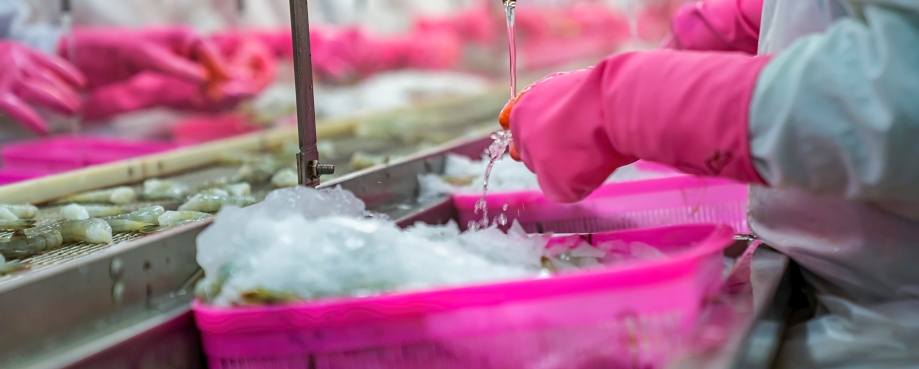
Shrimp is one of the most traded seafood commodities in the world1 — and one of the most challenging from a human rights perspective. Across hatcheries, farms, feed mills and processing facilities, workers continue to face low wages, long hours, unsafe conditions, insecure work and, in some cases, forced labour. These risks are not confined to one country or one supplier. They are widespread, persistent and systemic.
Over the past two decades, the sector has seen an increase in tools designed to address these risks: supplier codes of conduct, audits, certifications, grievance mechanisms, human rights impact assessments etc. Yet evidence from across the shrimp supply chain shows that serious labour rights concerns continue to arise — including in facilities that are audited or certified.
This raises a difficult but necessary question: why do these risks persist, despite so much effort to manage them?
Emerging research suggests that the answer lies less in the tools themselves and more in how companies buy from their suppliers. Recent research by the Ethical Trading Initiative (ETI), discussed in a webinar and expert panel with the International Labour Organization (ILO), the International Union of Food, Agricultural, Hotel, Restaurant, Catering, Tobacco and Allied Workers’ Associations (IUF), the Coles Group, and a human rights consultant on shrimp supply chains, highlights a critical gap in many companies’ approaches: purchasing practices.
The shrimp supply chain spans multiple stages and geographies, and risks to workers appear at every point. Hatchery workers may live on site, remain on call around the clock and earn below minimum wage. Farm workers often face informal employment, long hours and serious occupational health and safety risks. In processing — from peeling sheds to large factories — workers report high production targets, cold working environments, restricted freedom of movement and widespread reliance on temporary or subcontracted labour.
Migrant workers are particularly exposed. Research shared by Anyamanee from the ILO, drawing on interviews with more than 1,200 returned migrant workers in Southeast Asia, highlights “high recruitment fees leading to debt, wage compliance gaps, limited job mobility and severe restrictions on freedom of association.” Fear — of retaliation, job loss or deportation — remains a defining feature of many workers’ experiences.
Kirill from the IUF described the seafood sector as uniquely severe in terms of labour rights violations compared with other food industries. He said: ‘In many sourcing countries, workers cannot organise freely, migrant workers are excluded from representation, and alternative “worker voice” mechanisms fail to provide genuine protection.’
These are not anomalies. They are structural features of how the sector operates.
While audits, certifications, and codes of conduct are often used, they don’t address the issues by themselves.
ETI’s research highlights a structural compliance gap. Most social compliance tools focus on monitoring conditions at supplier level, offering snapshots of compliance at a single point in time. They rarely capture the commercial pressures that shape those conditions day to day.
This limitation was strongly reinforced by Roisai during the panel discussion. Many described “audit fatigue: repeated inspections by governments, food companies and certification schemes, without corresponding improvements in prices, payment terms or longer-term commitments.” Certification, in farmers’ words, “has become an entry ticket to the market — not a signal that good practice will be rewarded.”
Inconsistent standards across countries further undermine trust. Farmers see labour abuses reported in major exporting countries, yet certification continues to be granted. This erodes confidence that compliance systems reflect reality — and reinforces the perception that responsibility is demanded, but risk and cost are not shared.
To understand why labour risks persist, we need to also look upstream — at the commercial decisions buyers make.
Pricing is the clearest example. In the UK, retail prices for warm-water shrimp have risen over the past decade. Yet import prices paid to producers have fallen sharply. Ecuadorian shrimp prices are down nearly 20%, Indian shrimp by over 10%, and processed shrimp from Indonesia by more than 40%.
These price pressures cascade through the supply chain. When margins shrink, suppliers have less capacity to pay decent wages, invest in safety, or maintain stable employment. As Roisai explained, “After price pressures, workers often have to work faster, with less rest, to meet targets — the impact of buying decisions cascades down the chain.”
But price is not the only factor. Order volumes, forecasting, lead times and flexibility also matter deeply in aquaculture. Shrimp take three to six months to grow and are highly sensitive to environmental conditions. When buyers change orders at short notice or demand extreme flexibility, suppliers respond by relying on overtime, temporary labour or subcontracting — all of which are associated with weaker labour protections.
The discussion recognised that these impacts are often unintentional. Commercial teams operate in fast-moving, low-margin environments, and decisions are rarely made with human rights consequences in mind. Yet intention does not erase impact.
The risks of inaction are growing. Courts and regulators are increasingly clear that ethical commitments mean little if they are not reflected in how supply chains actually operate. In Italy, Giorgio Armani was fined €3.5 million because labour conditions at its supplier factories didn’t reflect the brand’s ethical claims. Similarly, Loro Piana was placed under court supervision after authorities found labour exploitation at subcontracted workshops. These cases show that companies can be held accountable even when abuses happen at supplier sites.
Looking ahead, emerging human rights due diligence legislation will require companies to identify, prevent and mitigate adverse impacts linked to their business decisions, including purchasing practices. The EU Corporate Sustainability Due Diligence Directive (CSDDD) will soon require companies in scope to identify, prevent, and mitigate adverse human rights and environmental impacts linked to their business decisions — including purchasing practices — ensuring that what may appear voluntary today becomes standard business practice.
Companies that act now — proactively and collaboratively — will be better positioned to manage legal, financial and reputational risk in the years ahead.
The webinar discussion made clear that improving purchasing practices is not about a single fix. It is about changing relationships, incentives, and internal ways of working.
Panellists highlighted that this work starts internally: “Raising awareness of the potential impacts of commercial decisions is essential. Embedding responsible purchasing requires shared understanding across teams.” They also stressed that recognising suppliers who exceed baseline labour standards could help drive stronger outcomes across the supply base.
Several priorities stood out:
The challenges in shrimp supply chains are complex — but they are not unsolvable. What is needed is a shift from downstream monitoring to upstream responsibility, and from isolated action to collective solutions.
ETI’s responsible purchasing practices initiative offers a practical way forward: bringing companies together to understand how their current buying decisions affect workers, to pilot changes collaboratively, and to develop guidance that supports wider industry uptake.
The message from the research and the panel was clear. Human rights risks in shrimp supply chains are not inevitable. They are shaped by choices. And with the right focus, those choices can be changed — deliberately, transparently and in partnership with the people most affected.
As the ILO notes, “We see some shift in employer mindset, and pressure from buyers can help accelerate this change. Labour standards and responsible purchasing practices are interconnected. Actions from buyers are essential to make these standards achievable.”
The question for companies now is not whether to act, but how quickly they are willing to align the way they buy with the standards they claim to uphold. ETI invites all retailers and food companies to join the Responsible Purchasing Practices in Shrimp Supply Chains initiative, proactively influencing how the supply chain evolves. Participation is practical, responsible, and verifiable — companies can contribute ideas, pilot new practices, and help shape industry-wide standards. To get started, reach out to Melissa Karadana at melissa.karadana@eti.org.uk and learn more about how your company can take action today.
[1]World fish market at a glance |Globefish | Food and Agriculture Organization of the United Nations