Get the latest
Subscribe to our email newsletters and stay up to speed on responsible business.

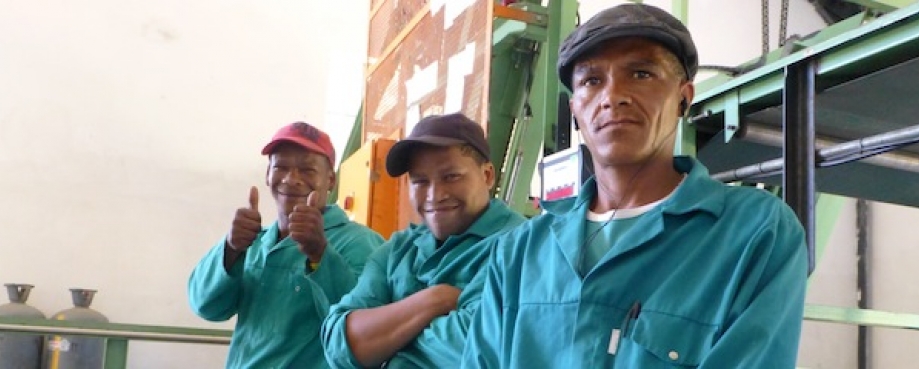
On my recent trip to South Africa's Western Cape to help draw out the lessons from a three-year diversity training programme with partners WIETA, I was told that some people feared that when Mandela passed away there would be civil war in South Africa. That's also what they feared when he was released from prison in 1990... but it did not happen. South Africa's challenge now is for its rainbow population to continue to live according to the principles of dignity, respect and tolerance that Mandela espoused.
"Respect" was a word that came up frequently when workers, supervisors and managers were telling me about their experience of the Comic Relief-funded diversity training programme that WIETA has been delivering.
As this Financial Times article on the ANC's land reform programme to transfer farms from white to black ownership explains "Rural regions tend to be among the most racially unreconstructed areas in post-apartheid South Africa..."
This means that in such regions, low level discrimination often persists – contravening the country's egalitarian constitution. ETI’s Equal Treatment of Workers programme in South Africa, delivered by WIETA, helps to tackle this by raising awareness among managers, supervisors and workers of all races about the value of respect in all communications.
The manager on a fruit and flower farm we visited told me "It's good to have the training. We have learned to make people responsible – they are not kids. We have learned that it is important to respect each other and give support."
The same message seems to have got through at each level of the workforce; a supervisor at the same farm said "At the training I learned that it was not right to swear at people, so I went to the workers and apologised to them for my behaviour. Now there is more respect between me and the workers." And one of these workers, told me "What I remember from the training is that you can't be rude, you must be respectful. Now we work nicely together and we do not call each other names." (This workers was 'coloured' - the name given to a South African ethnic group composed primarily of persons of mixed race.)
It was a story we heard over and over as we visited farms, fruit packing houses, vineyards and wine cellars. This seemingly small change of communicating more respectfully with each other has evidently had a big effect on workers and their supervisors and managers. One manager told me that improved communication has led to reduced conflict across the workforce which in turn has led to improved productivity. An important part of the training programme is teaching workers about their constitutional rights, including the right to be treated with respect regardless of race or gender – something many of them had no previous knowledge of.
But the fact remains that most of these managers are still white. Most supervisors in the Western Cape are coloured. And all workers are either coloured or black. Black and coloured workers often use the term "the white man" synonymously with the manager or owner. Due to the slow progress of the land reform programme, they are considering "moving away from “willing buyer, willing seller” policy under which white-owned land can only be procured if the owner agrees to sell."
This brings to mind Mandela's words at the Rivonia Trial; "During my lifetime... I have fought against white domination, and I have fought against black domination. I have cherished the ideal of a democratic and free society in which all persons live together in harmony and with equal opportunities. It is an ideal which I hope to live for and to achieve. But if needs be, it is an ideal for which I am prepared to die."
The last visit I made in South Africa was as a tourist to a vineyard called Solms Delta. There, I saw this ideal being lived out. When Mark Solms returned from Britain to his South African roots to take over the farm, he transferred a one third equity stake in the farm to its residents and workers. I was shown round by Joshua, who had once worked on irrigation ditches and was now the supervisor of the extensive vegetable and herb garden that provides the vineyard restaurant with its exquisite fresh ingredients. He was also an expert in ancient Greek techniques for sweetening grapes on the vine, in the stone age archaeology of his San forebears, and in the history of the slaves, labourers and other workers on the farm (who are commemorated on a wall of black tiles at the back of the farm museum). Joshua was full of pride in what, together with Mark Solms and his other fellow owners, the farm has achieved, and was full of ideas for new social, agricultural and entrepreneurial endeavours.
After the social unrest that led to strikes and violence in mines and farms across the Western Cape last year, many farmers came to Solms Delta to ask what their secret was, why hadn't any of the workers there joined the strikes?
Perhaps the answer can be summed up in one word – a word that Nelson Mandela embodied. Respect.