Home

Main menu

  • About ETI
    • Our members
      • Public reporting performance
    • Who we are
      • ETI's origins
    • What we do
    • Global presence
    • Governance
    • Our team
      • ETI Board members
    • Our Strategy
  • Home
  • Why ETI
    • Why join ETI
  • ETI Base Code
    • Base Code overview
    • Base Code clause 1: Employment is freely chosen
    • Base Code clause 2: Freedom of association
    • Base Code clause 3: Working conditions are safe and hygienic
    • Base Code clause 4: Child labour shall not be used
    • Base Code clause 5: Living wages are paid
    • Base Code clause 6: Working hours are not excessive
    • Base Code clause 7: No discrimination is practiced
    • Base Code clause 8: Regular employment is provided
    • Base Code clause 9: No harsh or inhumane treatment is allowed
  • Our approach
    • Membership
    • Programmes
    • Transparency
    • Meaningful stakeholder engagement (MSE)
  • Our expertise
    • Climate change & Just transitions
    • Crisis response
    • Gender equity in supply chains
    • Worker representation
    • Forced labour & modern slavery
    • Responsible purchasing practices
      • RPP in manufacturing
    • Human rights due diligence
      • HRDD legislation tracker
  • Resources
    • Guidance & reports
    • Blog
      • Blog series: Tackling gender-based violence through GRACE
    • Issues
      • Human rights due diligence (HRDD): a complete guide for business
        • What is human rights due diligence?
        • Human rights due diligence legislation and regulatory requirements
        • How to implement human rights due diligence in your company
        • HRDD risk assessment for supply chains
        • Supplier engagement and human rights due diligence
      • Forced labour & modern slavery: a complete guide for business
        • What is modern slavery? Definitions, forms and scale
        • How to identify forced labour in your supply chain
        • Remediation: what to do when forced labour is found
        • Modern slavery legislation: what businesses need to know
        • EU Forced Labour Regulation: what it means for your business
        • How to write a modern slavery statement
        • High-risk sectors and sourcing regions for forced labour
        • Forced labour and migrant workers in supply chains
      • Responsible purchasing practices: what they are and why they matter
        • How to implement responsible purchasing practices
        • Responsible purchasing practices and legislation: what companies need to know
        • Responsible purchasing practices by sector
    • Case studies
    • Training
    • Events
      • ETI Insights series
    • Impact report 2024-25

Breadcrumb

  1. Home
  2. guidance and reports

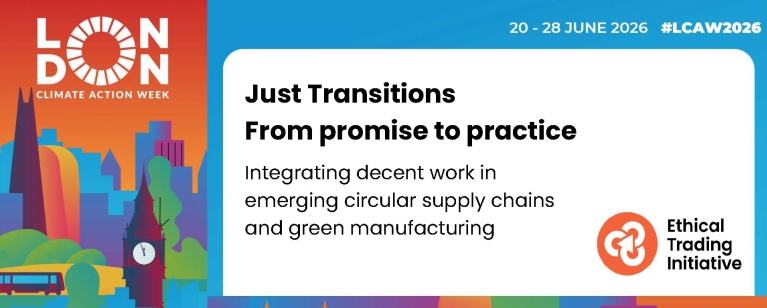
Just Transitions: From promise to practice

London-themed cover slide
  • Public
  • 29 June 2026
  • Presentations
Subject(s)
Just transitions
Climate change
ETI LCAW SMEP+ presentation

Integrating decent work in emerging circular supply chains and green manufacturing

Presentation shared at our event as part of London Climate Action week. 

The event featured insights and lessons from ETI’s recent work through the UK Government-funded SMEP Programme, where we have supported companies and organisations to integrate decent work into circular supply chains and green manufacturing initiatives across Africa and South Asia, including in the plastics, leather, textiles and organic waste sectors.

Building on these practical experiences, we explored concrete first steps organisations can take to operationalise just transitions in emerging circular supply chains and green manufacturing. Through facilitated roundtable discussions, participants also reflected on:

  • What works, and what doesn’t, in integrating decent work into environmental programmes that work with the private sector.
  • How to incentivise and support environmental initiatives to embed decent work outcomes from design, through implementation, to evaluation and beyond.
  • The role that funders, policymakers and implementing organisations can play in scaling effective approaches and advancing practical models for just transitions
File(s)

SMEP Programme briefing papers

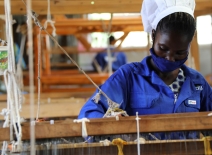
Fabric worker
A set of three briefing papers highlighting practical lessons for businesses, funders and implementing partners on how to make environmental initiatives more worker-centred, inclusive and effective.
Read more

Related content

  • ETI Insights recording: Just transitions in manufacturing - integrating human rights and environmental sustainability
  • SMEP Programme briefing papers
  • ETI Insights slides: Just transitions in manufacturing - integrating human rights and environmental sustainability
  • Just transitions in food, farming and fisheries: workshop resources
  • From Aims to Action: Why the Belém Action Mechanism matters for a just transition💥
  • Extreme Heat: Risks for workers in global supply chains

Get the latest

Subscribe to our email newsletters and stay up to speed on responsible business.

Subscribe

ETI elsewhere

  • Twitter
  • LinkedIn
  • YouTube

Footer

  • ETI Community
  • Accessibility
  • Contact
  • FAQ
  • Jobs at ETI
  • Press resources
  • Security & privacy
Other ETIs: Bangladesh, Denmark, Norway, Sweden
Ethical Trading Initiative | Registered No. 3578127