Get the latest
Subscribe to our email newsletters and stay up to speed on responsible business.

“This is the first time, in years of work, that someone actually listened to us and put that on paper.”
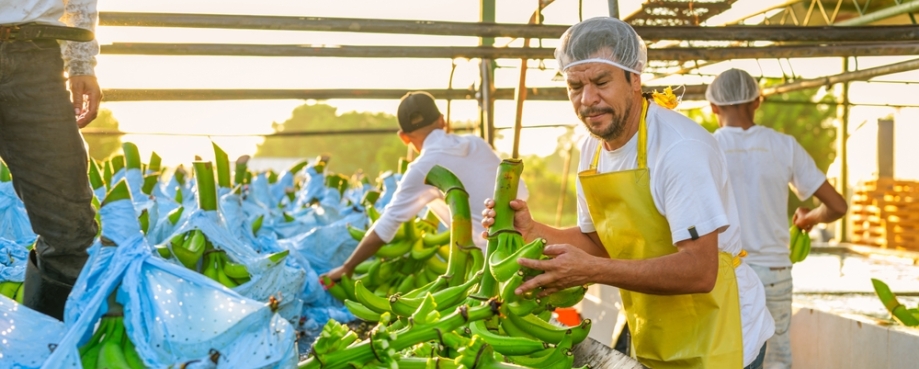
A supply chain stakeholder said this to me at this year’s Fruit Attraction, the international fresh produce trade fair in Madrid. We were there to discuss the findings of a joint assessment of how European retailers’ purchasing practices affect banana suppliers and workers.
The assessment was led by ETI and commissioned by Deutsche Gesellschaft für Internationale Zusammenarbeit (GIZ)’s, Sustainable Agricultural Supply Chains Initiative (SASI) and IDH, as part of the wider efforts on living wages in the banana sector. These efforts include the German Retailers Working Group on Living Income and Living Wages and the Banana Retail Commitment on Living Wages for banana supply chains in Belgium, the Netherlands and the UK. The assessment involved 12 European retailers and 34 Tier 1 and Tier 2 suppliers. It explored how retailers’ purchasing decisions affect suppliers’ businesses and, ultimately, workers’ conditions and wages, focusing on prices, lead times, forecasting, order changes and payment terms.
When I first attended Fruit Attraction last year, there was understandable skepticism around the idea. The banana sector has seen years of research and initiatives focused on human rights, decent work and wages. Some suppliers were wary that yet another assessment would ask them to explain their challenges without looking at the purchasing practices that can contribute to them.
Returning this year, I could feel the difference. We had said that this work would look at retailers’ own purchasing practices, and we had done exactly that. The conversations were warmer and more open, with real interest in the findings, and what should come next.
This was not another initiative asking suppliers to do more. It was a chance to look at what can change further up the supply chain.
Much of the work on human rights and decent work in bananas has focused on what happens at production level. This assessment worked the other way round. Through surveys and interviews, suppliers described how retailers’ current purchasing practices affect their businesses, what challenges they create, and ultimately how those challenges reach workers. We also spoke with retailers’ buying and human rights teams. Using ETI’s Food Framework, we scored each retailer’s practices. Retailers then used that feedback to look critically at their own practices and identify where changes could be made.
The findings revealed a clear gap between retailers’ confidence in their purchasing practices and suppliers’ experience of them.
Suppliers raised several recurring issues:
Together, these challenges make it harder to improve working conditions and wages.
The assessment also found differences in retailers’ approaches. That creates an opportunity for retailers to learn from each other. The full findings are in the report.
This assessment worked the other way round. Suppliers were asked about their experience of retailers’ current purchasing practices: how those practices affect their businesses, what challenges they create, and ultimately how those challenges reach workers and working conditions. This feedback was then combined with retailers’ perspectives from both commercial and human rights teams to identify where changes could be made.
Participating retailers have begun sharing results internally with relevant teams. They include ALDI Nord, ALDI SOUTH Group, Kaufland and REWE Group, all part of the German Retailers Working Group on Living Income and Living Wages, coordinated by SASI and GIZ. They also include Tesco, Jumbo and Colruyt, part of the Banana Retail Commitment on Living Wages, coordinated by IDH.
Each retailer will use its individual and group results to develop a company-specific action plan. The plans will validate and prioritise areas for improvement and set clear objectives and indicators of success, so progress can be monitored and approaches adapted over time.
Worker representatives will play an important role in this next phase. We met representatives from Latin America and West Africa in Madrid and hope to keep engaging with them as the plans develop. Their perspectives will be essential to making sure that changes lead to tangible improvements for workers.
There is still work to do, but this feels like an important step. Suppliers’ experiences are now part of the conversation, and retailers have shown they are willing to look honestly at their own practices.
We are inviting more retailers to join the action planning stage. Retailers who source bananas can draw on the assessment findings and supplier insights to develop action plans tailored to their own purchasing practices, alongside peers working on the same challenges.
The lessons from this work go well beyond bananas. Purchasing practices shape conditions for suppliers and workers across food supply chains. ETI members work with businesses, trade unions and NGOs to understand those impacts and take practical action on them, from pricing and planning to living wages.
If you would like to find out more about joining the action planning stage or becoming an ETI member, contact:
Read the report: Banana supply chain: How purchasing practices influence outcomes for producers, exporters, and workers