Home

Main menu

  • About ETI
    • Our members
      • Public reporting performance
    • Who we are
      • ETI's origins
    • What we do
    • Global presence
    • Governance
    • Our team
      • ETI Board members
    • Our Strategy
  • Home
  • Why ETI
    • Why join ETI
  • ETI Base Code
    • Base Code overview
    • Base Code clause 1: Employment is freely chosen
    • Base Code clause 2: Freedom of association
    • Base Code clause 3: Working conditions are safe and hygienic
    • Base Code clause 4: Child labour shall not be used
    • Base Code clause 5: Living wages are paid
    • Base Code clause 6: Working hours are not excessive
    • Base Code clause 7: No discrimination is practiced
    • Base Code clause 8: Regular employment is provided
    • Base Code clause 9: No harsh or inhumane treatment is allowed
  • Our approach
    • Membership
    • Programmes
    • Transparency
    • Meaningful stakeholder engagement (MSE)
  • Our expertise
    • Climate change & Just transitions
    • Crisis response
    • Gender equity in supply chains
    • Worker representation
    • Forced labour & modern slavery
    • Responsible purchasing practices
      • RPP in manufacturing
    • Human rights due diligence
      • HRDD legislation tracker
  • Resources
    • Guidance & reports
    • Blog
      • Blog series: Tackling gender-based violence through GRACE
    • Issues
      • Human rights due diligence (HRDD): a complete guide for business
        • What is human rights due diligence?
        • Human rights due diligence legislation and regulatory requirements
        • How to implement human rights due diligence in your company
        • HRDD risk assessment for supply chains
        • Supplier engagement and human rights due diligence
      • Forced labour & modern slavery: a complete guide for business
        • What is modern slavery? Definitions, forms and scale
        • How to identify forced labour in your supply chain
        • Remediation: what to do when forced labour is found
        • Modern slavery legislation: what businesses need to know
        • EU Forced Labour Regulation: what it means for your business
        • How to write a modern slavery statement
        • High-risk sectors and sourcing regions for forced labour
        • Forced labour and migrant workers in supply chains
      • Responsible purchasing practices: what they are and why they matter
        • How to implement responsible purchasing practices
        • Responsible purchasing practices and legislation: what companies need to know
        • Responsible purchasing practices by sector
    • Case studies
    • Training
    • Events
      • ETI Insights series
    • Impact report 2024-25

Breadcrumb

  1. Home
  2. blog

Where there's a political will...

  • Share on Facebook
  • Share on Twitter
  • Share on LinkedIn
  • Alistair Smith - Banana Link
  • 16 July 2015

Ecuador usually only makes the headlines in Europe for the famous 'refugee' in its London embassy. But when it comes to making living wages a reality for all salaried workers, this country provides a model that deserves to be news around the world.

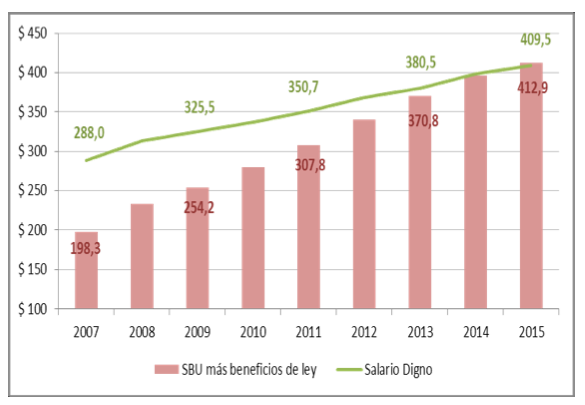
The Ecuadorian government led by President Rafael Correa has achieved what no other country has even set out to achieve. In the space of 8 years since coming to power, the legal minimum wage has been increased well beyond the rise in the cost of living. The explicit goal to close the gap between the minimum wage and a living wage was reached this year.

The new constitution of 2008 was born and approved in a process of popular participation. It includes an article that states that:

Remuneration will be fair, with a living wage that covers at least the needs of the working person as well as those of his/her family [...]

Thanks to successive hikes in the minimum wage, the average household of 1.6 earners can now purchase a basket of household goods and services. The cost of this basket is published monthly and is used as a proxy for a living wage.

Graph showing legal minimum wage and living wage levels, 2007-2015

Legal minimum wage and living wage levels, 2007-2015.

Red: legal minimum wage including obligatory 13th and 14th month payments.

Green: living wage level adjusted for Purchasing Power Parity.

We can all argue about the different methodologies and benchmarks that should be used to determine what a living wage is. But surely what matters most are the concrete actions taken by employers, trade unions and governments.

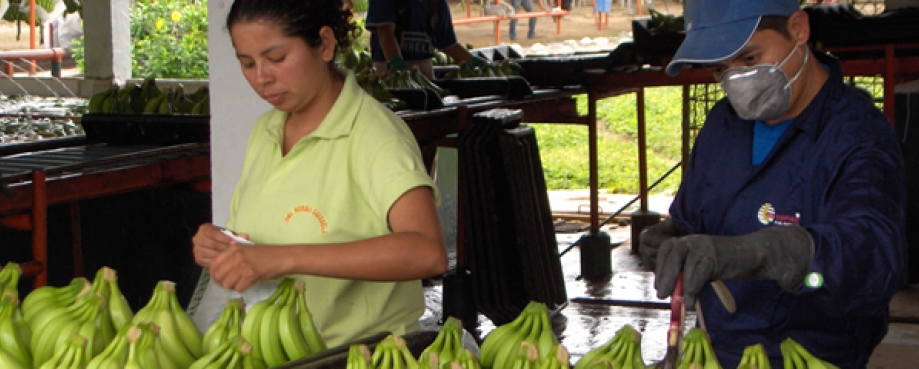
For 200,000 or more banana workers in Ecuador, the action of government supported by trade unions in the sector has meant a move from the poverty wages that prevailed only a decade ago to a more decent level of remuneration. The fact that this applies to all waged workers means that purchasing power across the economy has increased significantly. That a range of other policies to extend healthcare coverage, to end labour sub-contracting and to reduce employment discrimination have also been put in place shows that living wages should not exist in isolation from other policies that improve the quality of work.

Trade unions and employers now have the challenge and opportunity to improve on this base-line and create the conditions for truly decent work. Major problems still exist, especially in hazardous sectors like the banana or cut flower industries. These problems cannot all be resolved by government policy.

If the Ecuador example of setting a goal to close the gap between minimum wage and living wage could be shared with – and taken up by - other governments around the world, I'm sure we could advance the cause of ethical trade in game-changing ways. Could the governments of Myanmar, Bangladesh and Cambodia, for example, not be persuaded of the value of setting a goal for 'closing the gap' for the sake of millions of textile workers? 

Nor have higher wages in Ecuador meant less jobs. The country has one of the lowest unemployment levels in the Americas.

No, the issue comes back to one of the basic tenets of good policymaking: where there's a political will, there's a way.

ETI's blog covers issues at the intersection of business and human rights. We feature posts by, for and from our members and allies; we do not accept or offer payment for posts or publish content outside of these criteria. We welcome a range of insights and opinions from our guest bloggers, though don't necessarily agree with everything they say.

Stay up to date

Stay up to date with the latest from ETI via the following channels:
  • Email
  • Twitter
  • LinkedIn
  • Blog RSS

Related content

  • Living wage resources
  • ACT - initiative on living wages
  • Living wage initiatives
  • Living wage in the tea industry
  • Are we at the tipping point for getting the living wage in supply chains?
  • THE LEADERSHIP SERIES: ETI and me – why it’s important to empathise, talk and act to change supply chains

Get the latest

Subscribe to our email newsletters and stay up to speed on responsible business.

Subscribe

ETI elsewhere

  • Twitter
  • LinkedIn
  • YouTube

Footer

  • ETI Community
  • Accessibility
  • Contact
  • FAQ
  • Jobs at ETI
  • Press resources
  • Security & privacy
Other ETIs: Bangladesh, Denmark, Norway, Sweden
Ethical Trading Initiative | Registered No. 3578127