Home

Main menu

  • About ETI
    • Our members
      • Public reporting performance
    • Who we are
      • ETI's origins
    • What we do
    • Global presence
    • Governance
    • Our team
      • ETI Board members
    • Our Strategy
  • Home
  • Why ETI
    • Why join ETI
  • ETI Base Code
    • Base Code overview
    • Base Code clause 1: Employment is freely chosen
    • Base Code clause 2: Freedom of association
    • Base Code clause 3: Working conditions are safe and hygienic
    • Base Code clause 4: Child labour shall not be used
    • Base Code clause 5: Living wages are paid
    • Base Code clause 6: Working hours are not excessive
    • Base Code clause 7: No discrimination is practiced
    • Base Code clause 8: Regular employment is provided
    • Base Code clause 9: No harsh or inhumane treatment is allowed
  • Our approach
    • Membership
    • Programmes
    • Transparency
    • Meaningful stakeholder engagement (MSE)
  • Our expertise
    • Climate change & Just transitions
    • Crisis response
    • Gender equity in supply chains
    • Worker representation
    • Forced labour & modern slavery
    • Responsible purchasing practices
      • RPP in manufacturing
    • Human rights due diligence
      • HRDD legislation tracker
  • Resources
    • Guidance & reports
    • Blog
      • Blog series: Tackling gender-based violence through GRACE
    • Issues
      • Human rights due diligence (HRDD): a complete guide for business
        • What is human rights due diligence?
        • Human rights due diligence legislation and regulatory requirements
        • How to implement human rights due diligence in your company
        • HRDD risk assessment for supply chains
        • Supplier engagement and human rights due diligence
      • Forced labour & modern slavery: a complete guide for business
        • What is modern slavery? Definitions, forms and scale
        • How to identify forced labour in your supply chain
        • Remediation: what to do when forced labour is found
        • Modern slavery legislation: what businesses need to know
        • EU Forced Labour Regulation: what it means for your business
        • How to write a modern slavery statement
        • High-risk sectors and sourcing regions for forced labour
        • Forced labour and migrant workers in supply chains
      • Responsible purchasing practices: what they are and why they matter
        • How to implement responsible purchasing practices
        • Responsible purchasing practices and legislation: what companies need to know
        • Responsible purchasing practices by sector
    • Case studies
    • Training
    • Events
      • ETI Insights series
    • Impact report 2024-25

Breadcrumb

  1. Home
  2. blog

“Now I am bold”: Empowering tropical fruit workers in Africa

  • Share on Facebook
  • Share on Twitter
  • Share on LinkedIn
  • Jacqui Mackay - Banana Link
  • 13 November 2017

Following the third conference of the World Banana Forum, Jacqui Mackay of Banana Link discusses why rights education is key to securing decent work in the industry.

‘Now I am bold. I can talk to anybody. I can express myself anywhere just because I know my rights’.

These are the words of Caroline, a representative with the Fako Agricultural Workers Union (FAWU) in Cameroon, where together with the IUF and FAWU, Banana Link has been working on a capacity building programme to help workers know and secure their rights.


Last week, twelve representatives from African unions linked to the project participated in the third conference of the World Banana Forum in Geneva to share their challenges and advances, and most importantly to communicate with and learn from other stakeholders.


This year’s conference asked how we can achieve living wages and gender equity in the industry, and our partners in Cameroon and Ghana had a wealth of first-hand experience to offer.


Running from 2013 to 2016, the Comic Relief funded programme aimed to ‘Secure decent work in tropical fruit export production’ in both Cameroon and Ghana, based on the premise that workers need to know their rights in order to secure them and that elected representatives of independent unions need to have the capacity to negotiate effectively on behalf of workers.

Education, Education, Education

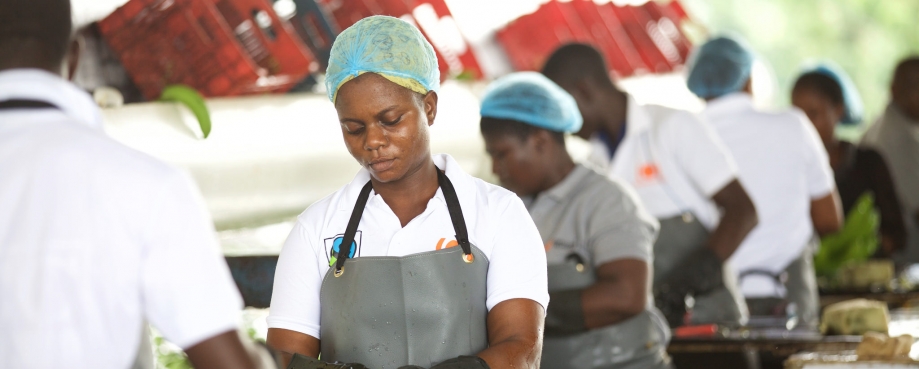
At the heart of the work has been the education of workers wherever possible, from the field to the trucks on the way to work. One representative described how he chooses a clause in the national labour code each week and then talks to his peers about this, gradually building their rights knowledge.


Over the project more than 10,000 workers participated in education sessions, while research showed a rise from 25 per cent to 65 per cent of workers in Cameroon who not only claimed to know their rights but could name them.


Pineapple and banana plantation owners reported significantly improved social dialogue, which in Cameroon resulted in improved working conditions, including in one year, a 48% reduction in pro rata deductions from wages. Meanwhile, FAWU reported a huge increase in grievances being settled in the field rather than coming to the union office.


However, perhaps the most striking impact of the project has been the work done to enable women to organise themselves and become more active decision makers both in their union and their workplace.


Last month nearly 30 FAWU women representatives and members gathered to share their achievements. These included successfully negotiating separate dressing rooms and toilets, women undertaking new roles such as welding or engineering and being trained for promotion to headwomen.


What’s more, during evaluation visits over the last year to Cameroon and Ghana we have continued to see highly motivated and skilled representatives resolving grievances, successfully negotiating improved workplace conditions, and consistently educating their members.


Education is a fundamental factor in enabling this change - whether it be helping a worker to understand the role of a Health and Safety Committee, giving women the confidence to speak up for their right to a workplace free of sexual harassment and gender based violence, developing the skills of an elected representative to handle grievances or building the capacity of a collective bargaining team.


That’s why, in the wake of this year’s conference, we’d like to urge all industry stakeholders to consider how they can help to ensure access to education at plantation level to empower women and men to secure decent work. Because it’s only when workers understand their rights that they are truly able to exercise them.


Download ‘Now I am Bold’ to read a brief impact report and watch our short film capturing the voices of some of those involved in the project detailed in this article.


ETI's blog covers issues at the intersection of business and human rights. We feature posts by, for and from our members and allies; we do not accept or offer payment for posts or publish content outside of these criteria. We welcome a range of insights and opinions from our guest bloggers, though don't necessarily agree with everything they say.

Stay up to date

Stay up to date with the latest from ETI via the following channels:
  • Email
  • Twitter
  • LinkedIn
  • Blog RSS

Related content

  • Our response to the GMB Union's call for multinational fruit company Fyffes to be expelled from ETI
  • Fairtrade: celebrating the first 20 years. What’s next?
  • The long road to ethical bananas: Part 2
  • Banana industry's progress on living wages
  • Chiquita, COLSIBA and the IUF collaborate to empower women banana workers in Panama
  • Banana Link: COVID-19 on Latin American plantations

Get the latest

Subscribe to our email newsletters and stay up to speed on responsible business.
Subscribe

ETI elsewhere

  • Twitter
  • LinkedIn
  • YouTube

Footer

  • ETI Community
  • Accessibility
  • Contact
  • FAQ
  • Jobs at ETI
  • Press resources
  • Security & privacy
Other ETIs: Bangladesh, Denmark, Norway, Sweden
Ethical Trading Initiative | Registered No. 3578127