Get the latest
Subscribe to our email newsletters and stay up to speed on responsible business.

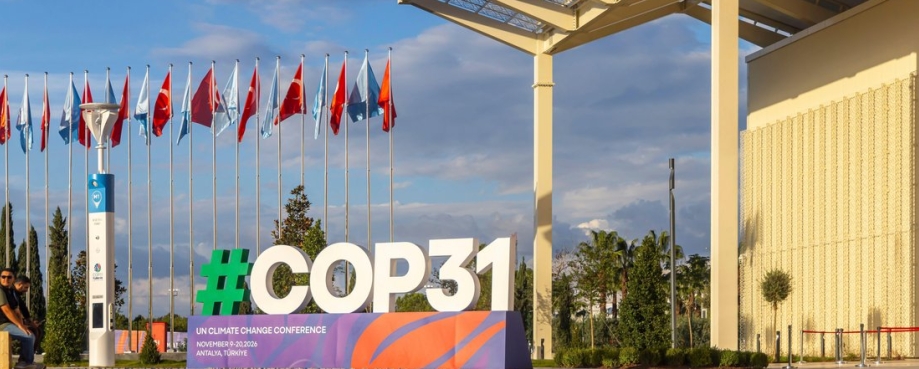
As the world’s attention shifts to Antalya for COP31, humanity needs negotiators to seize the urgency of now.
Climate crisis impacts are becoming more frequent and severe: we need ambitious and rapid action to keep any overshoot of 1.5 degrees as brief as possible. At the same time we need to scale-up adaptation to create resilient homes, communities, workplaces and supply chains.
The coming months will be testing. In September of this year the World Meteorological Organisation warned that the 2026-27 El Niño event has been supercharged by anthropogenic warming. It is expected to be the most severe El Niño in a thousand years, and scientists project ~450,000 excess deaths between June 2026 and February 2027. This follows a summer in which heat killed an estimated 50,000 people in European cities.
Against this frightening backdrop, is the good news that business, trade unions and researchers are not waiting for a breakthrough in global climate negotiations. First movers are busy identifying, testing and scaling-up practical actions that help keep workers safe as temperatures rise. At this year’s Africa Business and Human Rights Forum in Dakar, ETI convened a panel to share what is working.
Ethical Apparel Africa (EAA) is expanding its Maagrace garment manufacturing facility in Ghana from around 1,000 workers to 2,000. As summer temperatures have risen year on year, EAA have worked closely with worker representatives and specialists to design and implement a worker-centred heat risk management system. It combines:
We look at each of these in detail in the next blog in this series.
Pauline Watine, EAA’s Social Impact and HR Director, focused on shared responsibility. The workers bearing the cost of rising global temperatures are the people least responsible for the emissions causing them. Suppliers cannot close that gap alone.
“If we’re serious about just transition, heat should be part of how we think about the whole supply chain investment, alongside wages and lead times. It’s not just another line on an audit checklist. What I would love to see is brands asking their suppliers: what does your heat plan look like and what do you need to make it work?
Outdoor work, in farm settings for example, brings different challenges from indoor work, where there is more scope to manage workplace temperature. In Africa, almost half of all workers are employed in agriculture. Miriam Mogotu, Responsible Business Consultant, at Partner Africa shared good practice from her work with a large sugar producer.
Sugar production is notorious for life-threatening impacts on workers: the combination of heavy physical work, high temperatures and limited access to shade has led to chronic kidney disease among sugarcane workers in the Caribbean and Central America. Partner Africa’s client was keen to prevent similar harm to its employees. The first step was a proposal to move from five longer working days per week, to six shorter ones, finishing earlier to avoid the hottest hours of the afternoon. This proposed change constituted a significant change to workers’ terms and conditions, so under the collective bargaining agreement it was consulted on with their trade union.
New shift patterns had knock-on effects that needed managing, from adjustments to bus timetables to impacts in workers’ home lives. Partner Africa and their client paid particular attention to potential impacts for women workers, given domestic and care responsibilities. Women workers have since reported that they prefer their longer afternoons and evenings at home with their families.
Alongside these changes, the company took the following steps:
Pratik Mishra from the University of Sussex shared key insights from in-depth research with workers and employers in South Asia. They are highly relevant to Africa, the continent where workers are most exposed to excessive heat: the ILO estimates that 92% of its workforce is affected.
Pratik distilled findings from his work down to four pithy insights.
In Pratik’s words,
“when workers are perceiving heat stress, we must trust them and empower them so they can take breaks and take actions on their own behalf.”
But Pratik was clear that trust only works if workers can act on it. Piece-rate and daily wage rate workers are penalised if they take breaks, work shorter hours or take a rest day when temperatures rise. For those subsisting on the lowest wages, this is a cost they cannot afford. This is where action on heat meets the wider conversation on the importance of living wages and social protection.
Boitumelo Molete is Social Development Policy Coordinator at COSATU, the Congress of South African Trade Unions, which represents 1.6 million workers. In her interventions Boitumelo placed heat firmly within the workers’ right to a safe and healthy working environment. Responses to rising global temperatures, she said, must be informed by and built-on strategies already proven to work. That means:
Collective bargaining is central to this. It can secure tangible improvements to workplaces, including shift patterns, rest breaks, workloads and ventilation.
Boitumelo was equally clear, many workers around the world are currently far from these protections. 60 per cent of the world’s workers are informally employed, without written contracts, social protection or representation. This rises to 80 to 90 per cent in many low- and middle- income countries, including across Africa. Global supply chains rely on workers in informal employment across agriculture, construction, mining, and waste management and recycling. These workers are among the most exposed to extreme heat, yet rarely visible in companies’ social compliance systems. Formalisation, she argued, brings them visibility, protection and basic rights:
“It’s about making sure each and every worker in the economy is able to enjoy a safe environment to work in, wages that are decent, conditions that are decent – and that they can have sustainable livelihoods going forward.”
Protecting workers from the escalating impacts of the climate crisis, cannot be separated from securing decent work. The responsible business community has committed to respecting workers’ rights in global supply chains. Proactive, preventative action on heat, grounded in shared responsibility between supply chain actors, is now a critical part of meeting that commitment.
As negotiators in Antalya work out the details of the Just Transition Mechanism agreed at COP30 in Belém, we urge them to learn from the businesses, researchers and trade unions already showing what works in practice. ETI will keep bringing companies, trade unions and NGOs together to share these lessons and scale them up. As Boitumelo Molete explained in Dakar:
“We will only have a just transition if we are improving the lives of workers through adapting and putting measures in place to ensure that we’re moving to this low carbon economy in a way that takes workers with us, not leaving them behind.”